
Heat Exchangers for Large Heat Pumps and District Heating: Refrigerants, Heat Sources and Substations
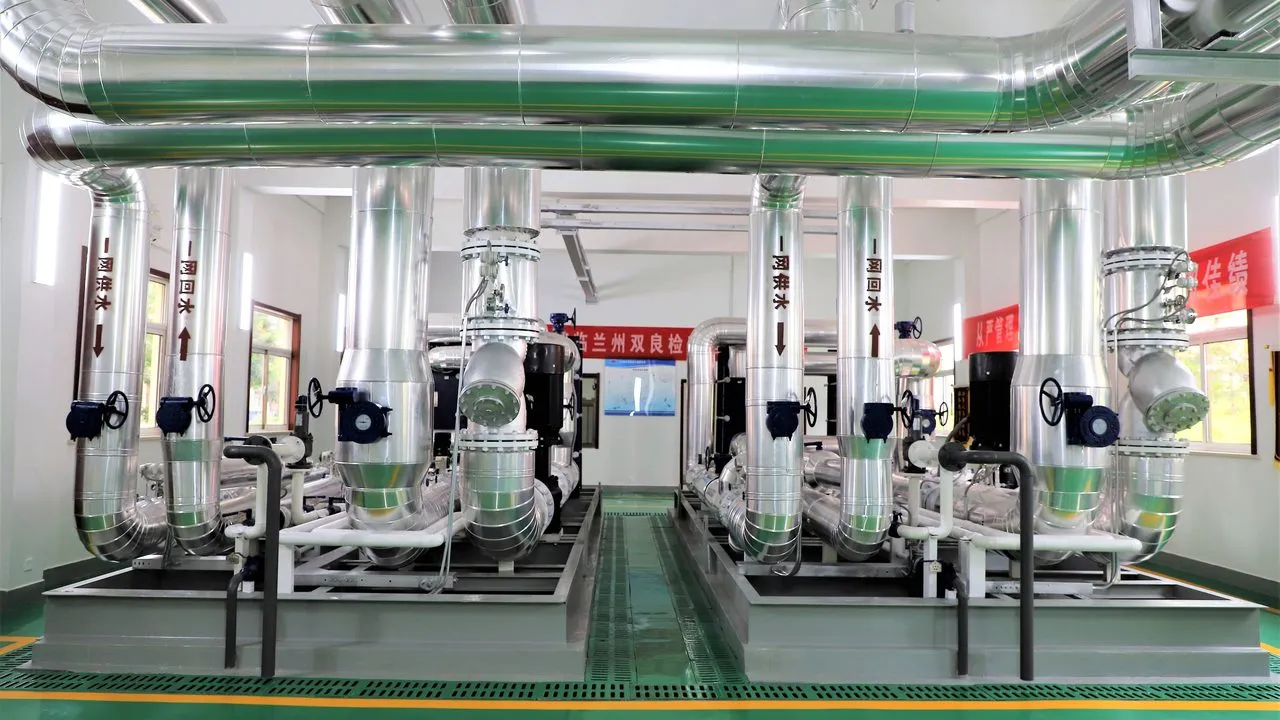
District heating networks in Europe are replacing coal and gas boilers with large electric heat pumps that take heat from seawater, rivers, treated wastewater or industrial waste heat. In Esbjerg, Denmark, a 70 MW heat pump that uses CO2 as its refrigerant and seawater as its heat source started supplying the district heating networks of Esbjerg and Varde at the end of 2024. In Odense, heat pumps with a total of 20 MW use ammonia to take heat from treated wastewater.
A heat pump plant of this kind is to a large extent a set of heat exchangers: on the heat source side, in the refrigerant cycle, and on the network side, down to the substations in the buildings. This guide explains where they are, how the refrigerant and the heat source change the design, and what to specify when buying them. The product catalog on this site includes semi-welded plate heat exchangers for ammonia refrigeration, wide-gap welded plate heat exchangers for fouling water, and heat exchange units for district heating. For a specific project, send your data through the RFQ form.
1. Where the Heat Exchangers Are
| Location | Heat exchanger | What it does |
|---|---|---|
| Heat source | Plate heat exchanger between the source water and an intermediate loop | Keeps seawater or wastewater out of the refrigerant evaporator |
| Evaporator | Refrigerant-to-water heat exchanger | The refrigerant evaporates and takes up heat from the source |
| Condenser or gas cooler | Refrigerant-to-water heat exchanger | The refrigerant gives off its heat to the district heating water |
| Subcooler, economiser, oil cooler | Smaller heat exchangers in the refrigerant cycle | Recover heat and raise the efficiency of the cycle |
| Substation | Plate heat exchanger between the network and the building | Separates the network from building heating and domestic hot water |
The Odense plant shows the pattern. Alfa Laval, which supplied its heat exchangers, describes semi-welded plate heat exchangers working as evaporators, condensers, subcoolers and oil coolers, with an intermediate circuit added between the wastewater and the ammonia evaporator. The plant cools the treated wastewater by about 5 °C and produces about four units of heat for each unit of electricity it uses.
2. The Refrigerant Decides Much of the Design
The EU F-gas Regulation (EU) 2024/573, which has applied since 11 March 2024, phases hydrofluorocarbons (HFCs) out of the EU market by 2050. Large heat pumps therefore increasingly use natural refrigerants, and each of them asks something different of the heat exchangers.
- Ammonia. Ammonia attacks copper, so copper-brazed plate heat exchangers are not used with it. SWEP's refrigerant handbook states that brazed plate heat exchangers for ammonia must use a nickel-based brazing material. Alfa Laval names ammonia among the aggressive media for its all-stainless fusion-bonded units. For large duties, semi-welded plate heat exchangers are common: the ammonia flows in welded plate pairs and the water in gasketed channels that can be opened for cleaning. Plate-and-shell and shell-and-tube heat exchangers are also used.
- CO2. CO2 systems run at much higher pressures than HFC systems. Danfoss's H48T brazed plate heat exchanger for transcritical CO2, for example, is rated for 140 bar on its primary side. Ask for the design pressure of the refrigerant side, and check that the heat exchanger and its certification cover it.
- Hydrocarbons such as propane. These refrigerants are flammable, and safety rules limit how much refrigerant a system may contain, so heat exchangers with a small internal volume are preferred.
Whatever the refrigerant, the heat pump maker usually specifies the refrigerant-side heat exchangers. If you are buying them separately, get the refrigerant, its pressures and temperatures, and the required pressure equipment code from the heat pump designer.
3. The Heat Source Decides the Water Side
- Seawater contains chlorides and marine growth. Titanium plates are common, with filtration upstream. See the marine and seawater checklist for materials.
- Treated wastewater fouls heat exchanger surfaces. In Odense, the discharged water is usually 8 to 22 °C, and an intermediate circuit separates it from the ammonia evaporator. A heat exchanger that is easy to clean, or a wide-gap design for dirtier water, is a common choice on the wastewater side.
- Industrial waste heat and data centers can supply warmer water, which raises the efficiency of the heat pump. See the heat reuse section of the data center liquid cooling guide.
- River and lake water brings seasonal temperature changes and debris, so filtration and the minimum winter temperature matter.
For any source, give the supplier the lowest and highest source temperatures over the year, a water analysis, the solids content and the planned cleaning method.
4. Network Temperatures Are Getting Lower
Older district heating networks run hot. Aalborg University's overview of district heating generations puts third-generation supply temperatures below 100 °C, and fourth-generation networks at about 50 to 60 °C supply, up to 70 °C in cold periods, with return temperatures around 25 °C. Lower supply temperatures make heat pumps more efficient, because the heat pump has to lift the heat less.
For heat exchangers, lower temperatures mean smaller temperature differences, so substations need heat exchangers designed for a close approach temperature, which usually means more heat transfer area. Low return temperatures are a goal in their own right: the more the water is cooled in the substations, the more heat each cubic metre of network water carries. When you specify a substation heat exchanger, give the required return temperature as well as the supply temperatures.
5. Substations and Heat Exchange Units
Many projects buy substations as prefabricated heat exchange units that combine plate heat exchangers, pumps, valves, instruments and controls. Examples on this site:
- ViEX's heat exchanger unit combines a heat exchanger, a circulating pump, a make-up pump and a control system, and lists typical duty points such as 130/80 °C on the network side to 95/70 °C on the building side.
- THT Juyuan's standardized heat exchange unit states pressure-drop targets below the Chinese national reference values, for example 40 kPa for the plate heat exchanger against a reference of 50 kPa.
- Accessen's MP series units have CE certification from TÜV Rheinland and serve BYD's commercial vehicle plant in Hungary.
Pressure drop matters because network pumps run all year. China has also published GB/T 47007-2026 on energy efficiency testing and evaluation of plate heat exchangers, and some manufacturers already have plate series tested under the earlier TSG R0010-2019 energy efficiency rules for heat exchangers. THT Juyuan, for example, states that eight of its plate series met level 1 in tests by the national heat exchanger quality inspection centre; see its level-1 energy efficiency plate heat exchangers.
6. Plan for Frequent Starts and Load Changes
Heat pumps that run on electricity are increasingly used to balance the power grid. The Esbjerg plant, for example, can be switched on and off many times a day. Every start and stop is a temperature cycle for the heat exchangers, which stresses gaskets and, in brazed units, the brazed joints. Tell the supplier how the plant will run, and ask whether the offered design has limits on cycling or on the rate of temperature change. The same point is covered for steam in the steam service guide.
7. What to Specify
| Item | What to give |
|---|---|
| Position in the plant | Source side, evaporator, condenser or gas cooler, subcooler, substation |
| Refrigerant side | Refrigerant, design pressure and temperature, required code |
| Heat source | Source type, temperature range over the year, water analysis, solids, cleaning method |
| Network side | Supply and return temperatures, design pressure, allowable pressure drop |
| Duty | Heat load at design and at minimum load |
| Operation | Number of starts and stops per day, rate of load change |
| Materials | Plate material, gasket compound where gaskets are used, brazing material for brazed units |
| Scope | Heat exchanger only, or a complete unit with pumps, valves and controls |
What This Means for Buyers
In heat pump and district heating projects, the refrigerant, the heat source and the network temperatures decide the heat exchanger design. Use designs that suit the refrigerant, such as no copper with ammonia and full pressure ratings for CO2. Protect the evaporator from dirty source water with an intermediate loop and heat exchangers that can be cleaned. Design substations for low return temperatures and a low pressure drop, and tell suppliers how often the plant will start and stop. For substations and building systems, the HVAC heat exchanger supplier checklist lists further questions.
Sources and Related Pages
- Cooling Post, largest CO2 seawater heat pump starts up (November 2024): https://www.coolingpost.com/world-news/largest-co2-seawater-heat-pump-starts-up/
- pv magazine, world's largest CO2-based seawater heat pump goes online (November 2024): https://www.pv-magazine.com/2024/11/29/worlds-largest-co2-based-seawater-heat-pump-goes-online/
- Alfa Laval, large ammonia heat pump brings cleaned sewage water to heat local community: https://www.alfalaval.com/media/stories/industrial-heat-pumps/large-ammonia-heat-pump-brings-cleaned-sewage-water-to-heat-local-community/
- European Commission, F-gas legislation, Regulation (EU) 2024/573: https://climate.ec.europa.eu/eu-action/fluorinated-greenhouse-gases/f-gas-legislation_en
- SWEP refrigerant handbook, practical advice: https://swep.net/refrigerant-handbook/8.-practical-advice/qw7
- Alfa Laval, fusion-bonded plate heat exchangers: https://www.alfalaval.com/products/heat-transfer/plate-heat-exchangers/fusion-bonded-plate-heat-exchangers/
- Danfoss, H48T brazed plate heat exchanger for transcritical CO2: https://danfoss.com/en/products/dhs/heat-exchangers/brazed-heat-exchangers/h48t
- Thorsen, Lund and Mathiesen, Progression of district heating, 1st to 4th generation (Aalborg University, 2018): https://vbn.aau.dk/ws/files/280710833/1_4GDH_progression_revised_May2018.pdf