
Heat Exchangers for Data Center Liquid Cooling: CDUs, Free Cooling and Heat Reuse
AI servers are pushing rack power beyond what air cooling can handle, and more data centers now cool chips directly with liquid. Behind every cold plate there is a chain of heat exchangers that moves the heat from the servers to the outside air, or to someone who can use it. Choosing those heat exchangers well decides how warm the facility water can run, how many hours the plant can cool without chillers, and how reliable the liquid loop is.
This guide is for data center owners, designers and contractors who are sourcing coolant distribution units (CDUs), plate heat exchangers or prefabricated cooling stations. The product catalog on this site includes Accessen's ACDU liquid-cooling distribution unit, its AIS outdoor prefabricated cooling station and its AQ/AA high-efficiency plate heat exchangers. For a specific project, send your loop data through the RFQ form.
1. Where the Heat Exchangers Are
A liquid-cooled data center usually has three loops. The technology cooling system (TCS) is the loop that runs through the cold plates in the servers. The facility water system (FWS) is the building loop. The heat rejection system sends the heat outside through cooling towers, dry coolers or chillers.
| Location | Heat exchanger | What it does |
|---|---|---|
| CDU | Liquid-to-liquid plate heat exchanger | Separates the server loop from facility water, so the server loop can stay clean, at its own pressure and with its own coolant |
| Free cooling | Plate heat exchanger between cooling tower water and chilled water | Cools without running chillers when outside conditions allow |
| Heat rejection | Closed-circuit cooling tower or dry cooler | Rejects heat to the air without exposing the facility water to it |
| Heat reuse | Plate heat exchanger to a heating network | Delivers waste heat to district heating or nearby buildings |
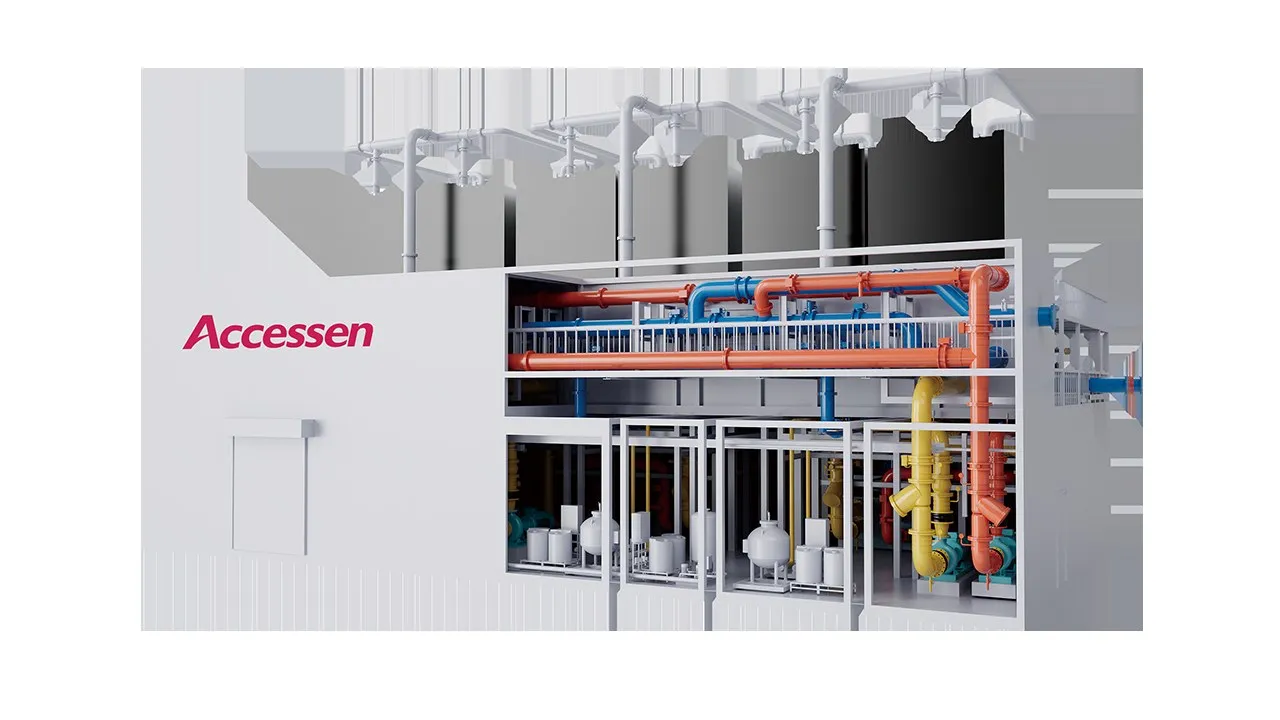
A real example: for ByteDance's 25 MW data center in Johor, Malaysia, Accessen supplied a prefabricated integrated cooling station built around closed cooling towers in a "3+1" arrangement, each rated at 3,150 kW, with pumps, make-up and dosing units in containerized modules.
2. ASHRAE W-Classes and Approach Temperature
ASHRAE Technical Committee 9.9 groups liquid-cooled IT equipment by the facility water temperature it can accept. In the 5th edition of its Thermal Guidelines for Data Processing Environments (2021), the classes are named after their upper limit: W17, W27, W32, W40, W45 and W+ (above 45 °C). As Upsite Technologies explains, compliance with a class means full, unthrottled operation of the IT equipment at every temperature within that class.
The CDU heat exchanger sits between the facility water and the server loop, so its approach temperature, the difference between the facility water supply and the server loop supply, matters a lot. For example, if the servers need coolant at 35 °C, a CDU with a 3 K approach can work with facility water up to 32 °C, while a 6 K approach needs facility water of 29 °C or colder. A closer approach lets the plant run warmer facility water, which means more hours of free cooling, smaller chillers or none, and easier heat reuse. The price is more plate area.
When you compare CDUs, compare them at the same facility water temperature, server loop temperature, flow rates and coolant. A headline capacity without these conditions says little.
3. Coolant and Material Compatibility
Many direct-to-chip systems use PG25. A Schneider Electric blog by a Motivair engineer describes PG25 as 75% water and 25% propylene glycol, notes that 25% is the concentration at which the mixture becomes biostatic, and says the Open Compute Project (OCP) recommends it. PG25 usually contains inhibitors to prevent corrosion of the copper in CDUs and cold plates, and it gives freeze protection to about -10 °C.
For the heat exchanger this means:
- Confirm that the plate material, any brazing material and the gaskets are approved for the coolant and its inhibitor package. Ask the coolant supplier and the heat exchanger supplier to agree on this in writing.
- Remember that a glycol mixture transfers heat less well than water. The same approach temperature needs more plate area with PG25 than with water.
- Keep the coolant data in the RFQ: glycol type and concentration, inhibitor brand, and the expected fluid temperature range.
4. Cleanliness: Flushing and Filtration
The same Schneider Electric blog notes that cold plates have fin spacing of around 50 microns, with future designs possibly tighter. Particles left from manufacturing, welding or installation can block those channels and overheat the chips. Cleanliness therefore starts at the factory that builds the CDU and its heat exchanger.
Ask suppliers:
- How the heat exchanger and piping are cleaned, and how the unit is sealed for shipping.
- What flushing procedure they recommend before IT equipment is connected.
- What filtration they provide on each loop, and whether filters can be changed without stopping the loop. Ratings differ by design: catalog data for Accessen's ACDU lists 100 to 200 µm filtration on the secondary side and 200 to 300 µm on the primary side. Check what the cold plate supplier requires.
5. Redundancy and Maintenance
A CDU feeds servers that cannot tolerate a loss of cooling, so redundancy matters as much as efficiency. Common measures are N+1 pumps, dual power supplies and controls that switch over automatically. On the heat exchanger side, two or more plate heat exchangers in parallel, each with its own isolation valves and with enough capacity left when one is out of service, let one unit be cleaned or repaired while the others keep cooling. A bypass around a single heat exchanger keeps the coolant moving but removes no heat.
The facility water side deserves attention too. Water from open cooling towers picks up dirt and biological growth, which fouls plate heat exchangers. Strainers before the heat exchanger, regular water treatment, or closed-circuit coolers like those used in the Johor project keep the facility loop cleaner.
6. Prefabricated Cooling Stations
More projects now buy the cooling plant as factory-built modules instead of building it on site. Accessen's AIS station combines chillers, plate heat exchangers, pumps, cooling towers, valves and controls in a pre-assembled outdoor package that needs only water and power connections on site. At Data Centre World Frankfurt 2026, the company said this approach can cut deployment time by up to 50% compared with traditional on-site installation; that is the company's own figure.
If you buy a prefabricated station, ask for the factory acceptance test procedure, the design codes for the piping and pressure equipment, the shipping module sizes and lifting points, and the interface list for site connections.
7. Heat Reuse
Warmer facility water, in the W40 and W45 range, makes the waste heat easier to use for district heating or nearby buildings, usually through a plate heat exchanger and sometimes a heat pump. Regulation is pushing in the same direction. According to a Danfoss summary of EU policy, under the recast Energy Efficiency Directive, data centers of more than 1 MW must use their waste heat or other heat recovery applications where this is technically and economically feasible. If heat reuse is part of the plan, include the heating network's temperatures and pressures in the RFQ from the start.
8. What to Specify in an RFQ
| Item | What to give |
|---|---|
| Heat load | Per CDU and for the whole plant, now and at full build-out |
| Facility water | Supply and return temperatures, flow, W-class, water quality |
| Server loop | Supply temperature required by the IT equipment, temperature rise, flow |
| Approach temperature | The target for the CDU heat exchanger |
| Coolants | Both loops: water, PG25 or other, with inhibitor brand |
| Pressure | Design pressure and allowable pressure drop on each side |
| Materials | Plates, brazing, gaskets, piping; materials to avoid |
| Cleanliness | Filtration rating, flushing and cleaning requirements |
| Redundancy | Pumps, heat exchangers, power supplies, controls |
| Controls | Communication protocol and monitoring points |
| Compliance | Certification and marking required in your market |
| Testing | Factory acceptance test and whether you will witness it |
9. What This Means for Buyers
In a liquid-cooled data center, the heat exchangers decide how warm the facility water can run and how much free cooling and heat reuse are possible. Specify the approach temperature, coolant and cleanliness requirements as carefully as the capacity, and compare offers at the same conditions. Chinese manufacturers such as Accessen now supply CDUs, plate heat exchangers and complete prefabricated cooling stations for data center projects at home and abroad, so it is worth including them in a supplier comparison. Our HVAC heat exchanger supplier checklist covers related points for building cooling systems.
Sources and Related Pages
- Upsite Technologies, changes to the liquid cooling chapter in ASHRAE's 5th edition Thermal Guidelines: https://www.upsite.com/blog/major-changes-to-ashraes-fifth-edition-of-thermal-guidelines-part-3-liquid-cooling-chapter-updates/
- Schneider Electric blog, coolant selection for data center liquid cooling (PG25): https://blog.se.com/datacenter/2026/08/14/what-coolant-for-data-center-liquid-cooling-pg25-dielectric-fluids-ashrae-recommendations/
- Danfoss, data center policies in the EU: https://www.danfoss.com/en/markets/buildings-commercial/shared/data-centers/data-center-policies-in-the-eu/
- HeatEx Direct, Accessen cooling station for ByteDance's Johor data center: https://heatexdirect.com/industry-news/news/accessen-bytedance-johor-data-center-cooling-station
- HeatEx Direct Accessen ACDU liquid-cooling distribution unit: https://heatexdirect.com/products/shanghai-accessen-co-ltd/liquid-cooling-distribution-unit-acdu
- HeatEx Direct Accessen AIS outdoor prefabricated cooling station: https://heatexdirect.com/products/shanghai-accessen-co-ltd/outdoor-prefabricated-integrated-cooling-station-ais