
Micron Semiconductor Case: How Accessen Plate Heat Exchangers Cool Process Water in Xi'an

In building B5 of Micron's plant in Xi'an, every minute of downtime is expensive. Chip packaging and test equipment gives off a great deal of heat, and the process cooling water (PCW) that removes it must stay at a steady temperature. If the PCW temperature drifts, yields fall and production can stop.
The question for the plant was how to exchange heat efficiently while keeping the purified or ultrapure process water in a sealed, closed loop, and how to find equipment that is both robust and economical to run.
A Demanding Cooling Duty
Micron's Xi'an plant is a key site for packaging and testing its DRAM products. In June 2023, Micron announced that it would invest more than RMB 4.3 billion in the plant over the following years, including a new building, and the expansion placed high demands on the plant's utility equipment.
In PCW cooling, conventional shell-and-tube heat exchangers transfer heat less efficiently, take up more space and are harder to clean. Semiconductor plants also set very strict water quality requirements: even a small leak or any contamination of the process water is unacceptable.
Accessen Plate Heat Exchangers in the B5 Utility Plant
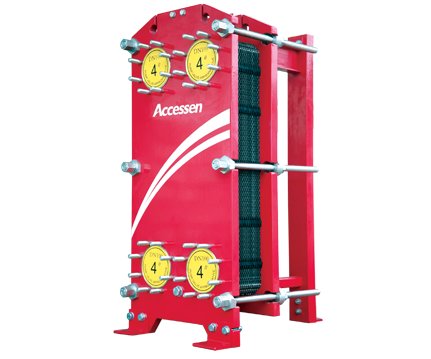
Accessen supplied AU-series gasketed plate heat exchangers to the utility plant room of building B5, where they keep the production lines at stable temperature and pressure. Three things made them a good fit:
- Energy efficiency. The AU series is certified as a Grade 1 energy-saving product. Grade 1 is also the highest of the three grades in China's national standard for plate heat exchanger efficiency, GB/T 47007-2026. Under the same operating conditions it transfers more heat with a lower pressure drop, which lowers running costs over the life of the equipment.
- Reliability. The products hold ASME, AHRI, CE and ABS certifications. In the PCW system, the plate heat exchanger transfers heat between chilled water from the chillers or cooling towers and the process water. The two streams stay separate, so the process water remains clean in its closed loop while the heat from the production tools is carried away. This reduces stoppages caused by temperature or pressure swings.
- Room to grow. The Xi'an plant is still expanding. A gasketed plate heat exchanger is compact, needing only about a third of the floor space of a shell-and-tube unit according to Accessen, and its heat transfer area can be increased later by adding plates instead of replacing the whole unit.
How the Heat Exchanger Works
A plate heat exchanger is a stack of thin metal plates pressed with a corrugated pattern. The warm process water and the cold chilled water are guided by gaskets into alternate channels between the plates and flow in opposite directions. The corrugations create strong turbulence even at low flow velocity, which breaks up the boundary layer of the fluid. Accessen puts the resulting heat transfer coefficient at three to five times that of a conventional shell-and-tube heat exchanger.
The gaskets do two jobs. The outer seal keeps fluid from leaking out, and the inner sealing lines direct each fluid into its own channels, so the hot and cold streams never mix inside the unit. This matters when one side carries semiconductor-grade ultrapure water.
Selection Range
Accessen offers more than 60 models covering different flow rates, water qualities and temperatures. The main limits of the range are:
- Flow rate up to 5,000 m³/h
- Design pressure up to 25 bar
- Heat duty up to 80 MW
- Temperature approach as close as 0.5–1 °C, and operating temperature up to 200 °C
- Plate materials including AISI 304, 316 and 316L, titanium and 254 SMO
Proven in Semiconductor Plants
At Micron's Xi'an plant, AU20M, AC65 and AU10L2 units are now in operation in the PCW system. Accessen's plate heat exchangers also serve other semiconductor and electronics manufacturers, including Samsung, ChangXin Memory Technologies, SMIC and BOE. For the full product range, see the Accessen AU, AN, AS, AP and AC series gasketed plate heat exchangers.