
How to choose a supplier of welded plate heat exchangers in China? BLOC, Wide Aisle and Fully Welded Construction Review Checklist
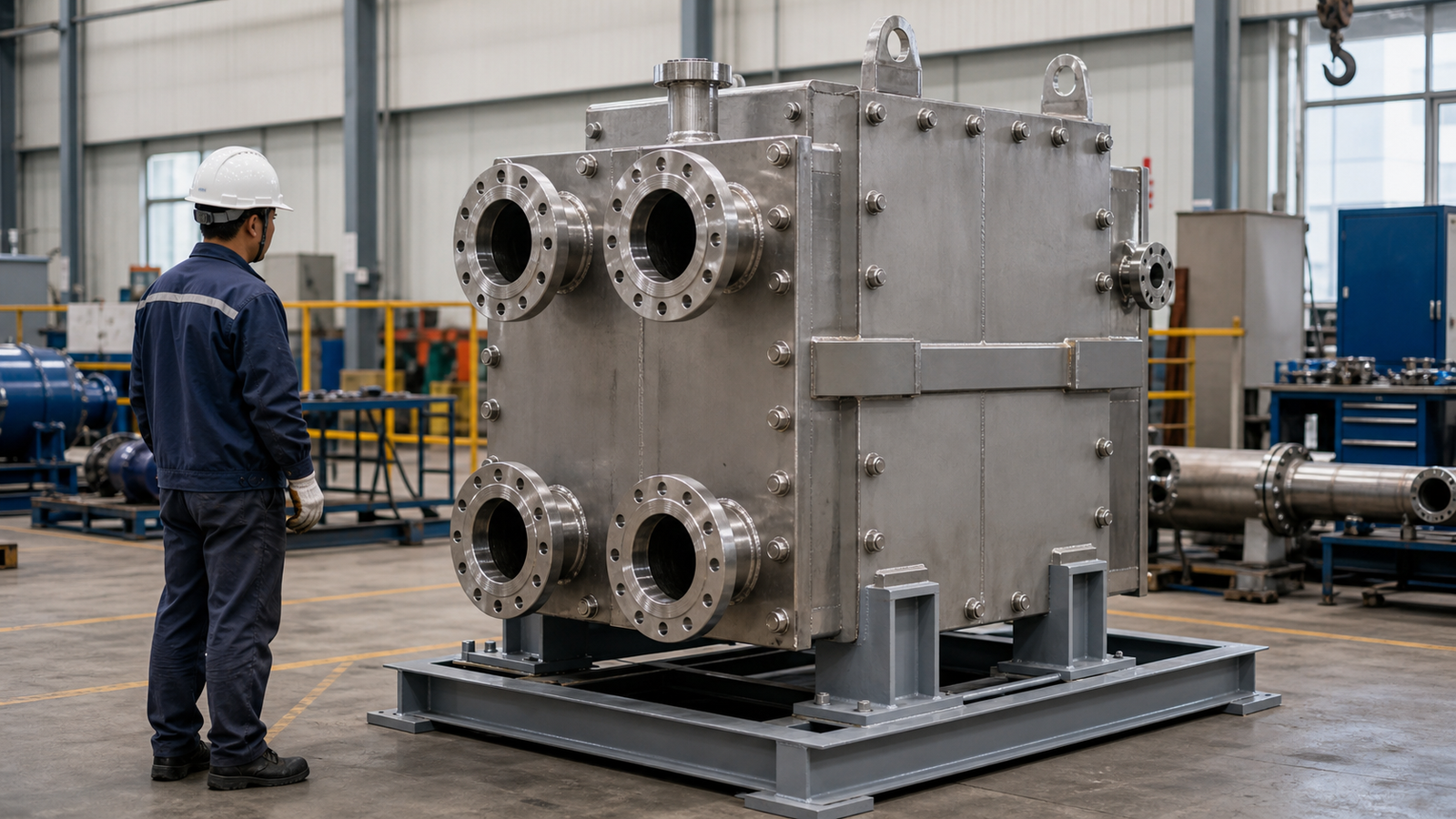
Welded plate heat exchangers usually appear in scenarios where the removable gasket plate equipment is not enough, the ordinary shell and tube type is too large, or the heat transfer efficiency is insufficient. It includes structures such as fully welded plate type, BLOC/block welded plate type, wide channel welded plate type, semi-welded plate type and plate and shell type. What the purchaser is concerned about is not the word "welding", but whether the welded structure can truly solve the problems of high temperature, high pressure, corrosion, leakage, scaling, cleaning and maintenance.
There are multiple related product entrances on the site, such as TP welded plate heat exchanger, HT-BLOC Welded plate heat exchanger, Wide gap welded plate heat exchanger and LS-BLOC Welded plate heat exchanger. These pages can help buyers understand structural differences before requesting quotes from suppliers.
1. First determine why the welding structure is needed
Not all projects require welding of plates. If the working conditions are clean, the temperature and pressure are moderate, and maintenance is convenient, the detachable plate type may be more economical. The welded structure will be more valuable if the project has high temperature, high pressure, strong corrosion, leakage-prone media, organic solvents, hazardous media, particle-containing slurries or cleaning agents that are not suitable for gaskets. It is recommended that the reasons for selecting welded construction be stated in the inquiry document, such as gasket compatibility, temperature pressure, leakage risk, particles or cleaning methods.
| Trigger conditions | Possible solutions | Need to verify |
|---|---|---|
| Gasket not suitable for media | Fully welded or semi-welded | Weld quality, leak detection |
| High Temperature and High Pressure | BLOC, Plate and Shell or Tube | Design Pressures, Materials and Approvals |
| Contains particles/fibers | Wide channel welded plate type | Channel width, cleaning method |
| Limited space | Welded plate or plate and shell type | Dimensions and maintenance space |
| Requires detachable maintenance | BLOC detachable construction | Plate bundle accessibility and sealing boundaries |
2. Welding quality is more important than marketing name
The key risk when welding plate heat exchangers is the weld seam. The supplier shall describe welding methods, welding consumables, welding procedure qualification, welder qualifications, heat input control, non-destructive testing, pressure testing and leak testing. The public statement of ASME BPVC Section VIII includes welding, inspection, testing and certification within the scope of pressure vessel rules; this reminds purchasers that in addition to plates, welding equipment also needs to look at the complete quality system.
If the supplier cannot explain the scope of weld inspection, pressure test standards and leakage determination methods, be cautious no matter how low the quotation is. For hazardous media or high-value working conditions, purchasers may also consider third-party inspections, material certificates and manufacturing progress witnesses.
3. Wide channel is not simply about making the gap bigger.
Wide channel welded plate heat exchangers are often used in media containing fibers, particles, high viscosity or easy to block. Its value lies in channel geometry, flow velocity distribution and cleaning path, rather than simply "channel width". A channel that is too wide may reduce heat transfer, and a channel that is too narrow may become clogged. The supplier should explain why a certain channel width, plate pattern and flow rate were selected, and describe the allowable particle size, solids content, viscosity range and cleaning methods.
DOE information on fouling and scaling states that insulating films on heat exchange surfaces can increase energy consumption; this also applies to wide-aisle equipment. Wide channels reduce the risk of clogging but are not a substitute for water treatment, filtration, CIP or regular inspections.
4. BLOC structure depends on maintainability
BLOC or block welded plate equipment is often used in high temperature, high pressure and compact scenarios. The purchaser should confirm whether the equipment can be disassembled for inspection, which parts can be replaced, how to clean the plate bundle, where the sealing surfaces are, and how fasteners and gaskets are managed. If the supplier only emphasizes "full welding and no leakage" but cannot explain the maintenance method, the later operation risks will be underestimated.
5. Documents recommended by suppliers
| File | Function |
|---|---|
| Thermal calculation summary | Determine area, pressure drop and terminal temperature difference |
| Structural illustration | Determine the plate bundle, shell, nozzle and maintenance method |
| Materials List | Determining Corrosion Resistance and Cost Assumptions |
| Welding and NDE Planning | Determining the Level of Quality Control |
| Pressure test plan | Determine acceptance boundaries |
| Installation and maintenance instructions | Determining cleaning and spare parts strategies |
| Deviation table | Determine whether project specifications are met |
6. Alternatives are also worth comparing together
There are overlapping boundaries between welded plate, shell and tube, spiral plate and wide channel equipment. For high viscosity and particle-containing media, you can compare wide channel welded plate and spiral plate heat exchanger; for high pressure and high temperature, you can compare BLOC and Shell-and-tube heat exchanger; For clean and efficient heat exchange, welded plate type and detachable plate type can be compared. Asking suppliers to provide main solutions and alternative solutions can reveal their true engineering capabilities.
7. Procurement Conclusion
When choosing a Chinese welded plate heat exchanger supplier, give priority to understanding of working conditions, welding quality, non-destructive testing, material selection, cleaning and maintenance and experience in similar projects. Low price is not necessarily wrong, but if the low price is based on reducing inspections, reducing materials, reducing area, or blurring cleaning methods, the later costs will be higher. You can first submit your working conditions through Inquiry Form, and then let the platform sort out the requirements and match them with relevant welding plate suppliers.
7. What are you most afraid of when purchasing welded plate?
Welded plate heat exchangers are often used in scenarios with higher temperatures, higher pressures, unsuitable gaskets, or more complex media compatibility, but they are not a simple replacement for "more advanced than gasketed plate heat exchangers." The purchaser needs to first confirm whether the equipment is allowed to be disassembled for maintenance, whether it may be blocked, whether mechanical cleaning is required, what the weld inspection requirements are, and how the pressure test and leakage test are performed. For media containing particles, easy to crystallize, easy to polymerize, or with high viscosity, a wide channel structure may be more suitable than an ordinary channel; for highly corrosive or high-risk media, material and welding quality are more important than pure heat exchange area.
The site has product pages related to TP welded plate type, HT-BLOC, LS-BLOC, fully welded plate type, wide channel welded plate type and A-BLOC. They all belong to the welded plate category, but their structures, maintenance methods and applicable scenarios are not exactly the same. When making inquiries, buyers can state the medium, whether it contains solids, whether it needs to be disassembled, whether there are cleaning requirements and project standards. In this way, the supplier can judge whether the ordinary welded plate, wide channel, plate and shell type or bloc structure is closer to the demand.
8. Let suppliers write risks into their quotations
Quotation proposals for welded plate versions contain a statement of assumptions and risks. If the supplier thinks that the media may be clogged, it can make suggestions for filtration, flushing or channel selection; if it thinks that the materials need to be upgraded, it can explain the reasons; if it thinks that certain working conditions are not suitable for welding plate type, it can also directly propose alternatives. Buyers want to encourage this kind of technical feedback because it is more valuable than just getting a low-priced model.
It is recommended that the supplier be required to list the welding method, main materials, design pressure, design temperature, test method, inspection items, cleaning and maintenance methods, recommended spare parts and deviation table in the inquiry materials. For petrochemical, chemical, pharmaceutical or seawater projects, project specifications or material restrictions can also be uploaded. Once the welded plate type is manufactured, the space for later modification is usually smaller than that of the gasketed plate type. Therefore, the more fully the parameters are confirmed in the early stage, the less rework and disputes can be reduced.
Data sources and site links
- ASME BPVC Section VIII Division 1: https://www.asme.org/codes-standards/find-codes-standards/bpvc-viii-1-bpvc-section-viii-rules-construction-pressure-vessels-division-1
- DOE on Fouling, Scaling and Energy Impact: https://www.energy.gov/cmei/femp/water-efficient-technology-opportunity-side-stream-filtration-cooling-towers
- Instructions for TEMA Standards type selection, inspection and maintenance: https://tema.org/standards/
- TP welded plate heat exchanger: https://heatexdirect.com/products/shanghai-heat-transfer-equipment-co-ltd/tp-welded-plate-heat-exchanger
- HT-BLOC welded plate heat exchanger: https://heatexdirect.com/products/shanghai-heat-transfer-equipment-co-ltd/ht-bloc-welded-plate-heat-exchanger
- Wide gap welded plate heat exchanger: https://heatexdirect.com/products/shanghai-heat-transfer-equipment-co-ltd/wide-gap-welded-plate-heat-exchanger
- LS-BLOC welded plate heat exchanger: https://heatexdirect.com/products/lanzhou-lanshi-heat-exchange-equipment-co-ltd/ls-bloc-welded-plate-heat-exchanger
- Spiral plate heat exchanger: https://heatexdirect.com/products/siping-viex-heat-exchange-equipment-co-ltd/spiral-plate-heat-exchanger
- Shell and tube heat exchanger: https://heatexdirect.com/products/siping-viex-heat-exchange-equipment-co-ltd/tubular-heat-exchanger