
Plate Heat Exchanger Gasket Materials: NBR, EPDM, HNBR or FKM?
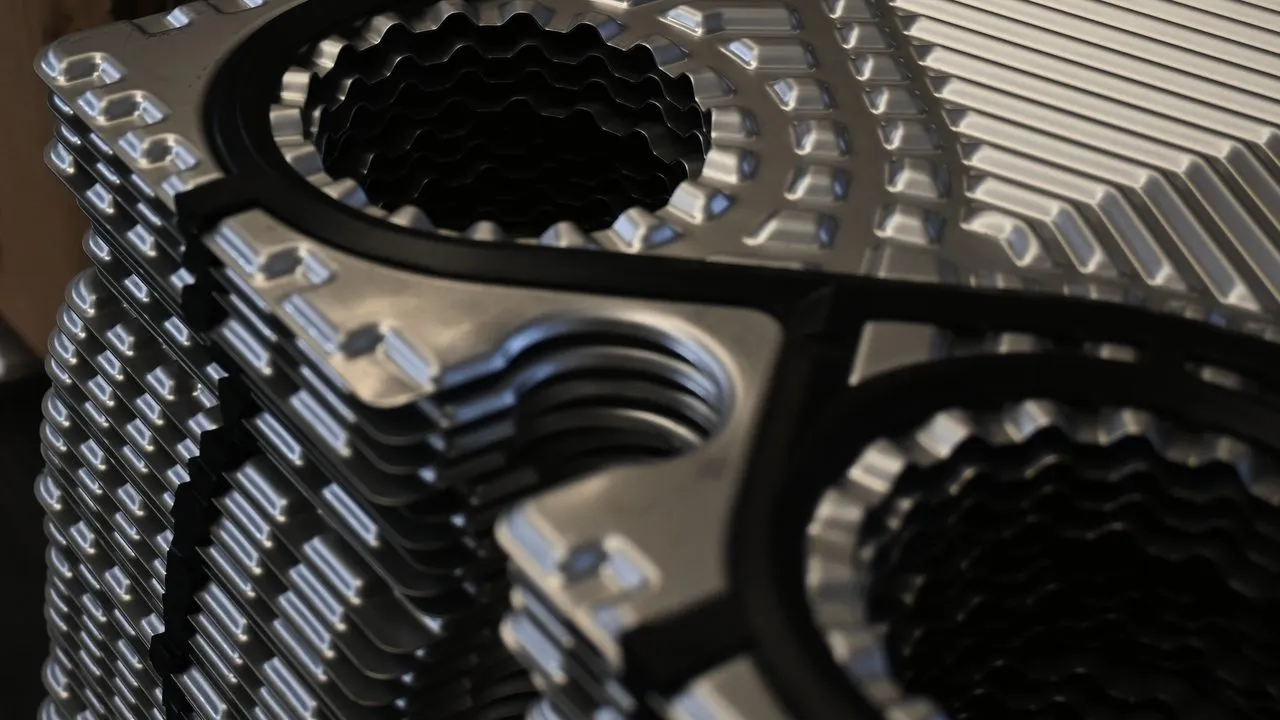
In a gasketed plate heat exchanger, the plates are usually stainless steel or titanium and rarely fail first. The gaskets are rubber. If the rubber swells, hardens or loses its elasticity, the unit leaks, so the choice of gasket material often decides whether a plate heat exchanger survives a duty. That choice is a chemistry question first and a temperature question second.
This guide compares the four elastomers used for most plate heat exchanger gaskets, NBR, HNBR, EPDM and FKM, and lists what to tell a supplier so the right one is offered. The product catalog on this site includes gasketed plate heat exchangers from Shanghai Heat Transfer Equipment with NBR, HNBR, EPDM, H-EPDM and FKM gaskets, and units from KDP and Lanshi. For a specific duty, send both fluids' data through the RFQ form.
1. The Short Version
The table sums up the material information published by Gislaved Gummi, a maker of plate heat exchanger gaskets, and the temperature ranges given in a Heat Exchanger World gasket guide.
| Material | Resists well | Avoid | Typical temperature range |
|---|---|---|---|
| NBR (nitrile) | Water, mineral oils, fuels, hydrocarbon solvents, vegetable oils and animal fats | Amines, ketones, aldehydes, low-molecular esters, organic acids, alkalis, and acids such as hydrochloric, nitric or sulphuric acid; ozone | About -10 °C to 110 °C |
| HNBR (hydrogenated nitrile) | The same oils and hydrocarbons as NBR, with much better heat ageing | The same chemicals as NBR; poorer at low temperature | About -10 °C to 160 °C in steam |
| EPDM | Water, steam, many acids and alkalis (sodium hydroxide excellent), alcohols, glycols, ketones, aldehydes, amines | Mineral oils, fuels, hydrocarbon solvents and heat transfer oils, vegetable oils and animal fats; strong oxidising acids such as nitric acid | About -10 °C to 150 °C; special steam grades higher |
| FKM (fluorocarbon) | Strong acids, salt solutions, aromatic hydrocarbons and heat transfer oils, chlorinated hydrocarbons; water and steam for suitable grades | Alkalis, low-molecular esters, ketones, ethers, aldehydes; amines and ammonia even at ppm level | Down to about -15 °C, continuous service up to 200 °C for suitable grades |
These are general ratings. Each gasket maker has its own compounds with their own limits, so the final check is always the data sheet of the compound offered.
2. Check Both Fluids, Not Only One
In a gasketed plate heat exchanger, each gasket seals its own channel and, with ring gaskets around the ports, the other fluid passing through those ports. Each gasket is therefore in contact with both fluids, and a plate pack normally uses one gasket material. The material has to suit both media.
Also include everything else that will flow through the unit:
- Cleaning chemicals. Give the chemical, concentration, temperature and how often the unit is cleaned. A gasket that resists the process fluid can still be damaged by the cleaning cycle.
- Water treatment chemicals. Gislaved Gummi warns that organic amines, which are found in many corrosion inhibitors, as well as ethanolamines and ammonia, attack FKM even at ppm levels. This degradation of the FKM can also cause stress corrosion cracking of stainless steel plates at high temperature.
- Upset conditions. If a different fluid can enter the unit during start-up, flushing or a process upset, mention it.
3. Temperature: Rating and Life
A temperature rating is the highest temperature the compound is meant to take, not a temperature at which it lasts as long as at a lower one. Rubber ages faster when it runs hot: it hardens, takes a permanent set and pushes back less against the plates. Leave a margin between the operating temperature and the rating, and ask the supplier for the expected gasket life at your actual temperature.
Ratings for the same material differ between compounds. A trade article in Processing magazine describes an EPDM compound able to run for at least one year at 175 °C in hot water or steam, and an HNBR grade for offshore oil coolers with continuous operation up to 175 °C. These are specific compounds, not general limits for EPDM or HNBR. For steam heating, see can a plate heat exchanger use steam.
4. Oils and Hydrocarbons: NBR or HNBR
NBR is the usual choice for lubricating oil, hydraulic oil and fuel coolers. Its weak points are heat ageing and ozone. HNBR resists the same fluids and keeps its properties much better at high temperature, which is why it is used in hot oil coolers and oil and gas service. Gislaved Gummi rates its HNBR grades up to 160 °C in steam and down to -10 °C. One point to note from the Processing article: hot water and steam can be more damaging to HNBR than hydrocarbons, so for an oil cooler the water side matters too.
Neither NBR nor HNBR is the right choice for alkalis, amines, ketones or strong acids.
5. Water, Steam and Glycols: EPDM
EPDM is the standard gasket for district heating, HVAC, domestic hot water, glycol loops and many steam heaters. It resists water, steam, sodium hydroxide and many acids and amines, and it is not attacked by the corrosion inhibitors normally used in steam systems. It must not be used with oils, fuels, hydrocarbon solvents, hydrocarbon heat transfer oils, or vegetable oils and animal fats.
That last point catches some buyers. A gasket that works well on the water side of a food plant can fail quickly if the product contains fat, so food duties with oils or fats need a different compound.
6. Acids and Aggressive Hot Duties: FKM
FKM resists strong acids, salt solutions, aromatic hydrocarbons, heat transfer oils and chlorinated hydrocarbons, and suitable grades take water and steam at high temperature. It costs more than NBR or EPDM. Its weaknesses are alkalis, esters, ketones, ethers, aldehydes, amines and ammonia. Before choosing FKM for its acid resistance, check the cleaning chemicals and any water treatment additives against that list.
7. Food, Beverage and Pharmaceutical Duties
Gaskets in contact with food need a food-contact compound and a declaration of compliance. In the EU, food-contact materials fall under Regulation (EC) No 1935/2004, with good manufacturing practice under Regulation (EC) No 2023/2006. In the United States, rubber articles for repeated food contact are covered by FDA 21 CFR 177.2600. Alfa Laval, for example, lists FDA CFR Title 21 and both EU regulations as the standards its gasket materials comply with. Ask the supplier for the declaration for the exact compound offered, not a general statement about the material.
8. Glued or Clip-On Gaskets
Gaskets are fixed to the plates either with adhesive or mechanically, with clips that hold the gasket in the plate groove. Glue-free gaskets can be replaced without removing old adhesive, which makes regasketing on site faster. Which method can be used is set by the plate design, so spare gaskets must match the plates: a clip-on gasket will not fit a plate made for glued gaskets. Alfa Laval's spare parts shop, for instance, lists clip-on, glued and taped gaskets, depending on the plate model.
9. Storage of Spare Gaskets
NBR is sensitive to ozone, so spare NBR gaskets should be kept in sealed plastic bags, away from light and heat. Gislaved Gummi describes ozone resistance as excellent for EPDM and FKM, so storing those gaskets for several years is not critical. Whatever the material, follow the gasket maker's storage instructions and record when each set was made. For spare parts planning, see the spare parts buying guide.
10. What to Tell the Supplier
| Item | What to give |
|---|---|
| Both fluids | Name, composition and concentration, including trace components |
| Temperatures | Normal, maximum and minimum on each side, including start-up and cleaning |
| Pressures | Operating and design pressure on each side |
| Cleaning | Chemicals, concentrations, temperatures and frequency |
| Additives | Corrosion inhibitors, biocides, glycol type |
| Food contact | Required regulations and declarations |
| Operating pattern | Continuous, or frequent starts and stops |
| Existing unit | Current gasket material and how long it lasted, if you are replacing gaskets |
What This Means for Buyers
Pick the gasket for both fluids and the cleaning cycle, not only for the main product. Use NBR or HNBR for oils, EPDM for water, steam and glycols, and FKM for acids and hot hydrocarbons where no alkalis, amines or ammonia are present. Leave a temperature margin, and ask for the compound name and its data sheet in the quote, so that replacement gaskets years later can be ordered in the same material. When comparing suppliers, the gasketed plate heat exchanger supplier checklist lists the other questions to ask.
Sources and Related Pages
- Gislaved Gummi (Hexpol), gasket material information, NBR: https://www.hexpol.com/gislavedgummi/wp-content/uploads/sites/34/2020/05/File-General-Information-NBR.pdf
- Gislaved Gummi (Hexpol), gasket material information, HNBR: https://www.hexpol.com/gislavedgummi/wp-content/uploads/sites/34/2020/05/File-General-Information-HNBR.pdf
- Gislaved Gummi (Hexpol), gasket material information, EPDM: https://www.hexpol.com/gislavedgummi/wp-content/uploads/sites/34/2020/05/File-General-Information-EPDM.pdf
- Gislaved Gummi (Hexpol), gasket material information, FKM: https://www.hexpol.com/gislavedgummi/wp-content/uploads/sites/34/2020/05/File-General-Information-FKM.pdf
- Heat Exchanger World, guide to plate heat exchanger gaskets: https://heat-exchanger-world.com/?p=69916
- Processing magazine, three materials for challenging requirements: https://www.processingmagazine.com/home/article/55347291/three-materials-for-challenging-requirements
- Alfa Laval, heat transfer service across brands (gasket materials and compliances): https://www.alfalaval.com/globalassets/documents/service/maintenance/heat_transfer_service_allbrands_-description_en.pdf
- Alfa Laval spare parts shop, gaskets: https://shop.alfalaval.com/en-gb/gaskets-alfa-laval--3492492
- HeatEx Direct gasketed plate heat exchangers: https://heatexdirect.com/products/shanghai-heat-transfer-equipment-co-ltd/gasketed-plate-heat-exchanger