
Heat Exchanger Spare Parts Purchasing Guide: Plates, Gaskets, Tube Bundles, Bolts and Maintenance Documents
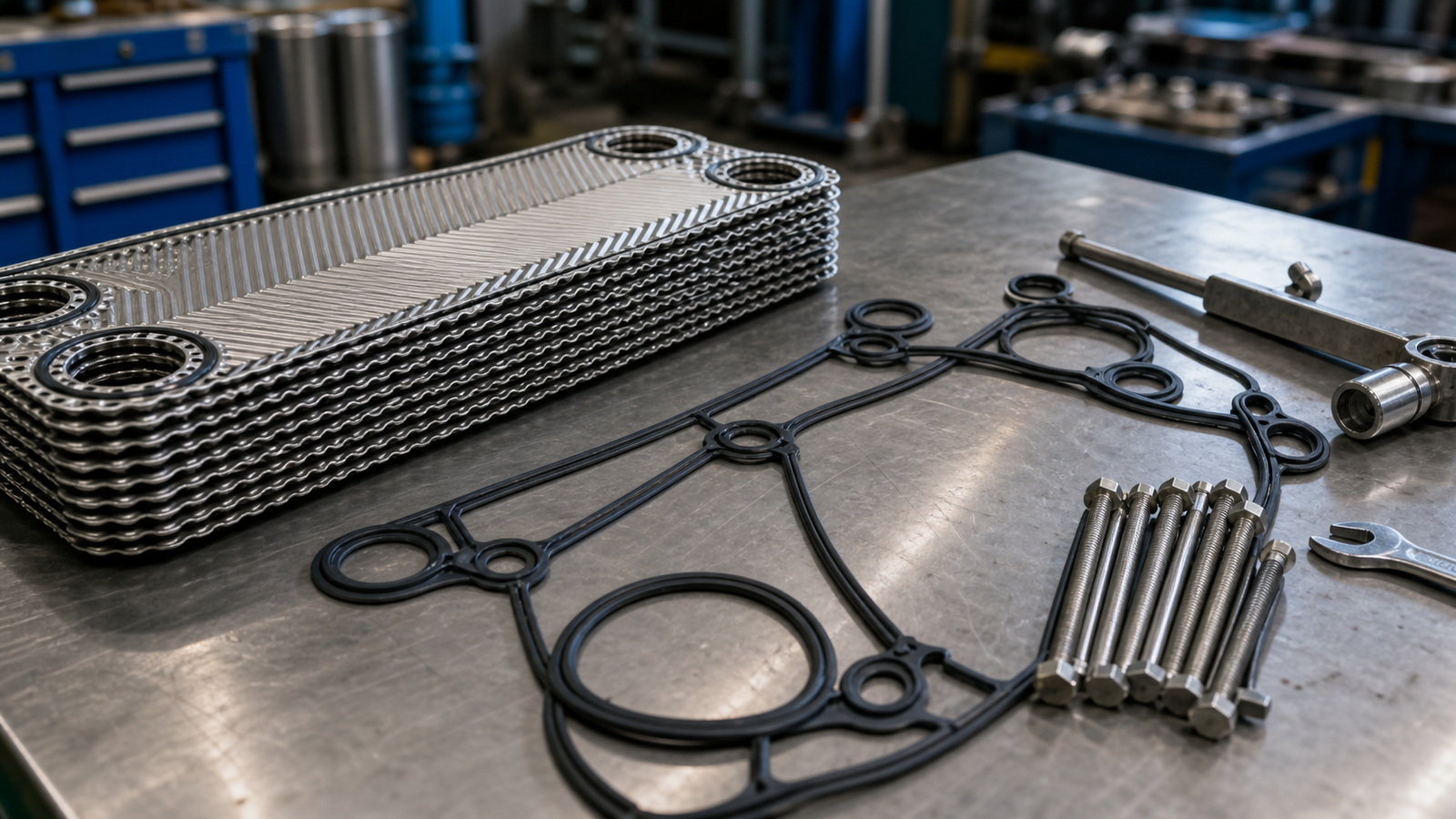
Purchasing heat exchanger spare parts may seem simple, but the actual risks are high. If the plates and gaskets of plate heat exchangers do not match in model, material or compression size, it may lead to leakage, plate deformation or performance degradation; if the gaskets, tube bundles, tube plugs, fasteners and sealing surfaces of shell and tube heat exchangers do not match, it will affect the pressure boundary and maintenance cycle. Purchasing spare parts is not about finding an "almost" part, but confirming the identity, material, size, working condition and maintenance records of the equipment.
The Product Catalog on the site includes a variety of plate, welded plate, shell and tube and air heat exchangers. Before purchasing spare parts, it is recommended to confirm which category the equipment belongs to, and then decide whether you need original spare parts, compatible spare parts or modified spare parts.
1. The first step in spare parts procurement: identify the equipment
The most important information is not the quantity, but the device identity. The purchaser should collect nameplate photos, original drawings, purchase orders, equipment models, serial numbers, manufacturer names, years of operation, design pressure, design temperature, plate quantity, nozzle size and maintenance records. Without this information, suppliers can only guess based on photos, and the error rate will be high.
| Device type | Key identifying information |
|---|---|
| Detachable plate heat exchanger | Plate type, number of plates, plate thickness, gasket model, pressing size |
| Brazed plate heat exchanger | Model, number of plates, interfaces, brazing material, design pressure |
| Welded plate heat exchanger | Structural type, plate bundle number, seals, cleaning methods |
| Shell and tube heat exchanger | TEMA type, tube diameter and length, tube sheet, gasket, tube bundle drawings |
| Air heat exchanger | Fin tube specifications, fans, motors, pipes, anti-corrosion |
2. The models and compatibility of plates and gaskets need to be confirmed
The plates of detachable plate heat exchangers have differences in corrugation angles, corner holes, sealing grooves, plate thickness, materials and plate shapes. Even if they look similar in appearance, they may not be interchangeable because of different sealing lines, compaction dimensions, or flow channel directions. The same goes for gaskets: EPDM, NBR, FKM and other materials have different applicable temperatures and chemical compatibility, as well as different adhesive, snap-on or adhesive-free installation methods.
The purchaser can provide the supplier with photos of old plates, corner hole dimensions, plate length and width, plate thickness, pressing dimensions, old gasket photos and media information. For Detachable Plate Heat Exchanger and Detachable Plate Heat Exchanger, the compaction size and gasket material are the core of spare parts procurement.
3. Spare parts materials must be confirmed according to actual working conditions
Many spare parts failures come from "purchased as is" but operating conditions have changed. For example, the increase in chloride ions in cooling water, replacement of CIP cleaning agents, temperature rise, and the addition of oil dirt or particles in the medium will all change the material suitability. According to DOE information, dirt, scale, and microorganisms will form an insulating film on the heat exchange surface and increase energy consumption; if water quality and dirt issues are not dealt with when purchasing spare parts, simply replacing new plates or new tube bundles may quickly cause repeated failures.
4. Pay attention to the pressure boundary of shell and tube spare parts
Shell and tube heat exchanger spare parts include gaskets, bolts, tube plugs, tube bundles, head gaskets, supports, baffles, tube boxes and seals. Since shell and tube equipment are often pressure vessels, spare parts replacement usually depends on more than just size. The public instructions for ASME BPVC Section VIII cover pressure vessel design, fabrication, inspection, testing, and certification; this means that pressure boundary related components require certification of materials, inspection records, and proper installation procedures.
The TEMA standards page also mentions that its new edition contains an installation, operation and maintenance appendix, which reminds purchasers that spare parts procurement and maintenance procedures should be combined with the equipment standard rather than ordered separately.
5. It is recommended to establish a spare parts ledger
A spare parts ledger should be established for each heat exchanger, including at least the equipment number, model, manufacturer, date of operation, plate/tube bundle information, seal material, last cleaning date, leakage record, compaction size, inventory quantity and supplier contact information. The ledger can reduce repeated measurements and enable quick order placement during downtime.
| Ledger fields | Purpose |
|---|---|
| Equipment number | Avoid confusion of similar equipment |
| Plate or tube bundle models | Quick matching spare parts |
| Materials | Preventing incorrect substitutions |
| Pressing size | Key to reassembly of detachable panels |
| Cleaning records | Determine dirt trends |
| Inventory quantity | Control downtime risk |
6. When to consider modifications instead of spare parts
If the equipment leaks repeatedly, the pressure drop continues to rise, the cleaning cycle is getting shorter and shorter, the plates are severely corroded, the tube bundle is blocked, or the working conditions have changed significantly, continuing to purchase spare parts may not be the best solution. At this time, the supplier can be asked to evaluate replacement or modification, such as changing from ordinary detachable plate type to wide channel, from old shell and tube type to high-efficiency plate type, and from old air heat exchanger to new finned tube solution. The purchaser can first submit the old equipment information and fault records through Inquiry Form, so that the supplier can determine whether it is spare parts, repair or complete machine replacement.
7. Spare parts inquiry template
Suggestions for spare parts inquiry include: equipment nameplate, original manufacturer, model, serial number, year of operation, photos of old spare parts, quantity, material requirements, medium, temperature, pressure, cleaning method, whether it is urgent, whether original manufacturer compatibility certificate is required, and whether material certificate is required. For plate equipment, the pressing size and number of plates can also be provided; for shell and tube equipment, drawings and pressure boundary requirements can be provided.
7. Spare parts procurement should start with the identity of the equipment.
It is recommended to confirm the model and compatibility of plates, gaskets and maintenance parts first. Even if the dimensions appear to be similar, different plate shapes, corrugations, joints, gasket grooves and materials may be different. The purchaser can first confirm the equipment brand, model, serial number, plate quantity, plate material, gasket material, compaction size, operating years and past maintenance records. If the old equipment data is lost, at least prepare photos of the nameplate, the entire machine, the interface, the plate and the gasket. This will give the supplier the opportunity to determine whether there is a match.
For spare parts inquiries, the attachment upload function is very suitable for such needs. You can upload old nameplates, plates, gaskets and on-site photos, and state in the additional description that you need "original model spare parts, alternative spare parts or complete machine replacement suggestions." If the equipment is too old or the model is unknown, the supplier may not be able to guarantee full compatibility. In this case, the supplier can clearly state the risks rather than defaulting to replacement.
8. Maintenance plans are more cost-effective than temporary purchases
Many plate heat exchanger problems do not occur suddenly, but are caused by long-term scaling, gasket aging, compression size changes, improper cleaning or media changes. The purchaser can combine spare parts procurement and maintenance plans: prepare gaskets, spare plates, cleaning agent recommendations, compaction size records and leak detection plans before planned shutdown; record pressure drop, temperature difference and leakage after cleaning; track performance changes after re-operation. In this way, it can be determined whether it is simple maintenance, or whether it is necessary to adjust the selection or replace the entire machine.
When comparing quotations, in addition to the price of a single gasket or a single plate, you can also look at the minimum order quantity, production cycle, material certificate, packaging method, whether installation guidance is provided, and whether a complete maintenance package is supported. For overseas purchases, transportation time and spare parts reserves are more critical than unit price. It is recommended to ask about "recommended one-year spare parts package" and "key spare parts delivery date" in the inquiry information at the same time, so as to reduce the risk of future downtime.
Data sources and site links
- DOE Cooling Tower Side Filtration, Fouling and Scaling Instructions: https://www.energy.gov/cmei/femp/water-efficient-technology-opportunity-side-stream-filtration-cooling-towers
- ASME BPVC Section VIII Division 1: https://www.asme.org/codes-standards/find-codes-standards/bpvc-viii-1-bpvc-section-viii-rules-construction-pressure-vessels-division-1
- TEMA Standards maintenance related instructions: https://tema.org/standards/
- HeatEx Direct removable plate heat exchanger: https://heatexdirect.com/products/shanghai-heat-transfer-equipment-co-ltd/gasketed-plate-heat-exchanger
- HeatEx Direct detachable plate heat exchanger: https://heatexdirect.com/products/lanzhou-lanshi-heat-exchange-equipment-co-ltd/detachable-plate-heat-exchanger
- HeatEx Direct wide gap welded plate heat exchanger: https://heatexdirect.com/products/shanghai-heat-transfer-equipment-co-ltd/wide-gap-welded-plate-heat-exchanger
- HeatEx Direct shell and tube heat exchanger: https://heatexdirect.com/products/siping-viex-heat-exchange-equipment-co-ltd/tubular-heat-exchanger
- HeatEx Direct air heat exchanger: https://heatexdirect.com/products/siping-viex-heat-exchange-equipment-co-ltd/air-heat-exchanger