
How to choose the supplier of removable gasket plate heat exchanger in China? Procurement Review Checklist
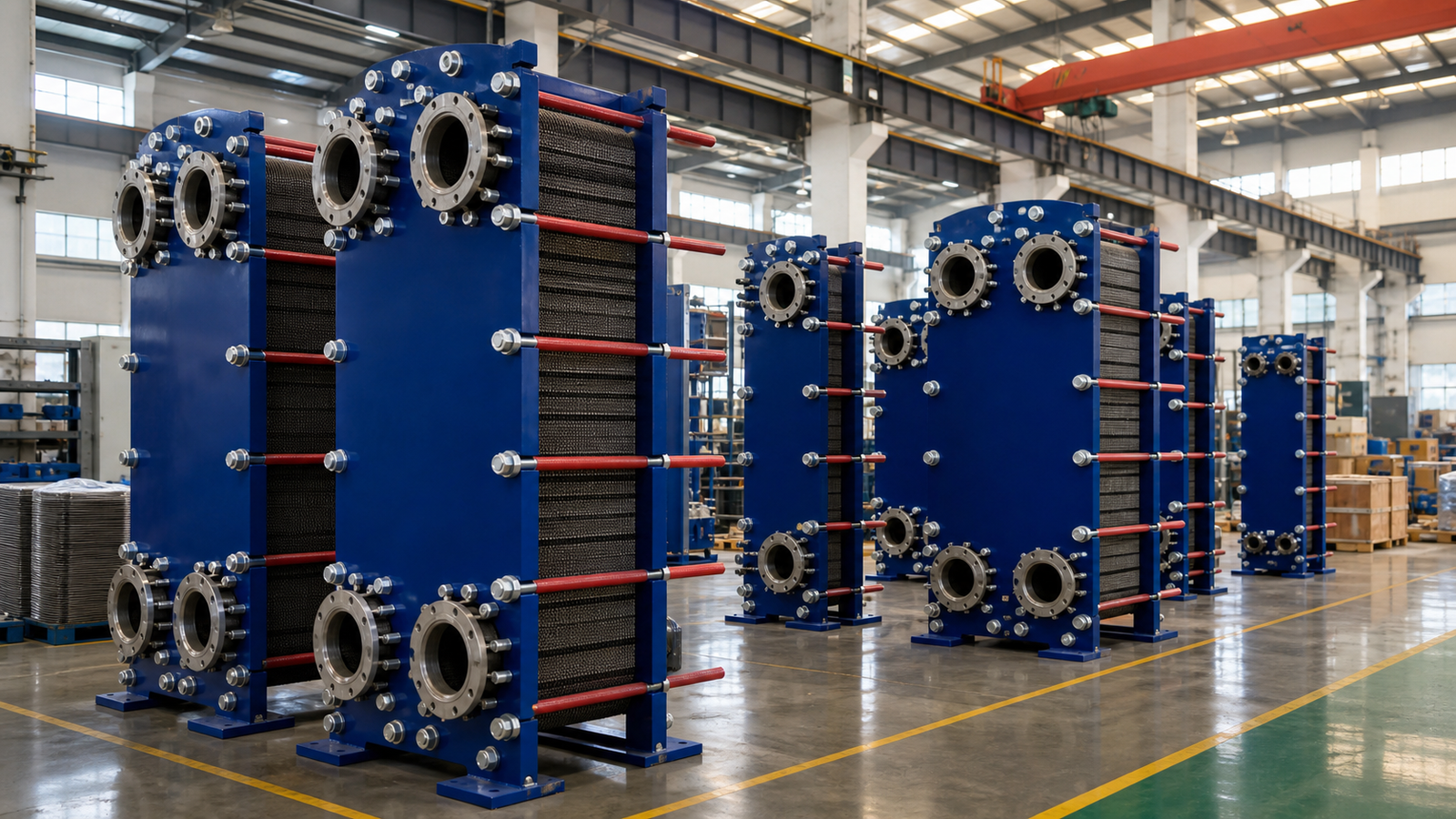
Removable gasket plate heat exchangers are one of the most common products when overseas buyers contact Chinese heat exchanger suppliers. It is commonly used in water-to-water heat transfer, HVAC, food and beverage, pharmaceutical, chemical cooling, waste heat recovery and utility systems. Its advantages are compactness, high heat transfer efficiency, and easy maintenance after opening the plate; risks focus on plate quality, gasket compatibility, frame strength, compaction size, and whether the supplier can select models according to working conditions.
You can view Detachable plate heat exchanger, Detachable plate heat exchanger and Plate Heat Exchanger and other product pages. The following list is suitable for comparing Chinese suppliers' plate, gasket, maintenance and spare parts capabilities.
1. First confirm whether the supplier actually makes boards or only assembles them.
The core of the detachable panel device is not the frame, but the panels. Plate corrugations determine heat transfer, pressure drop, distribution, cleaning and fouling tendencies. Suppliers with stable plate shapes, molds and pressing capabilities can usually have better control over plate thickness, corrugation consistency and seal groove quality. Suppliers who only do assembly may also be able to meet simple projects, but in replacement, expansion or complex working conditions, the source and compatibility of the boards need to be explained.
| Audit items | Can be confirmed with suppliers | Procurement judgment |
|---|---|---|
| Plate type | What plate type and corner hole combinations are available | Whether it can adapt to different pressure drops and heat loads |
| Mold | Whether to own the mold or outsource it stably | Affects long-term spare parts supply |
| Plate materials | 304, 316L, titanium, nickel alloy, etc. | Directly related to media corrosion |
| Plate thickness | Common plate thickness ranges and reasons for selection | Impact on pressure, life and cost |
| Seal groove | Gasket positioning method and leakage path | Affect installation and maintenance reliability |
2. Gaskets are the most risky spare parts
Many plate heat exchanger failures are not caused by broken plates, but by wrong selection of gasket materials, poor bonding, aging, incorrect pressing size, or incompatible cleaning agents. The purchaser can provide the media, temperature, cleaning agent, CIP concentration and operating cycle, and let the supplier recommend EPDM, NBR, FKM or other materials. Compared with general statements such as "high temperature resistance" and "corrosion resistance", it is more valuable to ask the supplier to explain the reasons and restrictions for material selection.
Food, beverage, pharmaceutical and hygienic systems are particularly concerned with gasket dead spaces, cleaning residues, batch traceability and spare parts lead times. For equipment that is frequently disassembled and assembled, the gasket installation method, positioning stability and compaction size management are more important than the initial price.
3. Frame and compaction dimensions determine maintenance quality
Detachable plate heat exchangers require fixed compression plates, movable compression plates, guide rods, clamping bolts and brackets to keep the plate bundle compressed. The supplier provides the compression size range in the quotation and explains the control requirements for the initial compression of the new gasket, re-tightening after operation, and reassembly after maintenance, which will make subsequent maintenance clearer. If the purchaser does not record the compression dimensions, leakage or plate deformation may easily occur when the gasket is subsequently replaced.
4. Clean fluid and dirt fluid should be judged separately.
The removable gasket plate heat exchanger is suitable for many clean fluids and low to medium viscosity conditions, but it is not suitable for all dirty media. DOE information on cooling tower side filtration states that suspended particles, biofilm, and scale can create an insulating layer on heat exchange surfaces and increase energy consumption. The purchaser can clearly explain the particles, fibers, hardness, oil stains, microorganisms and cleaning methods in the medium, so that the supplier can judge whether the ordinary detachable plate type is suitable.
If the medium contains a large amount of fibers, particles or high viscosity, wide gaps, wide channels, tubular or welded structures can be considered as alternative directions. Wide gap welded plate heat exchanger on the site is the reference direction for this type of boundary scenario.
5. It is recommended to provide a thermal work summary when quoting
A professional supplier usually not only gives the model and price, but also explains the heat exchange area, number of plates, single plate area, expected pressure drop, interface size, design pressure, design temperature, material, weight and overall dimensions. The purchaser does not necessarily need to recalculate all thermal work, but does need to be able to compare the assumptions of different suppliers. If supplier A quotes as clean water and supplier B quotes as dirt-containing margin, the price difference is not simply expensive or cheap.
6. Spare parts and compatibility must be written into the contract
When purchasing a plate heat exchanger, you can also ask for a set of recommended spare parts: gaskets, a small number of plates, clamping bolts, end plate gaskets and special tools. For replacement projects, it is recommended to confirm whether the new supplier's board is compatible with the old equipment to avoid purchasing only similar sizes. A safer approach is to provide the old nameplate, plate photos, corner hole dimensions, plate thickness, hold-down dimensions and old gasket model numbers.
7. Supplier review conclusion
Give priority to suppliers who can clearly explain plates, gaskets, pressing dimensions, thermal engineering summary and maintenance methods. For quotes that are obviously low, focus on materials, plate thickness, gasket brand, testing and spare parts. The purchasing goal of removable gasket plate heat exchangers is not to buy the cheapest one at one time, but to make the equipment controllable throughout the cleaning and gasket replacement cycle.
If you are ready to compare multiple Chinese suppliers, you can submit working conditions and attachments through Inquiry Form, or browse Manufacturers List to identify candidate manufacturers.
8. What should gasket plate suppliers focus on?
The purchasing risk of gasketed plate heat exchangers usually does not lie in "whether there are plates or not", but in the selection of plate type, gasket material, plate material, compaction size, maintainability and spare parts continuity. If the supplier can explain why the selected plate type is suitable for your flow rate, pressure drop and medium characteristics, the quotation will be easier to compare; if the medium is corrosive, the supplier can be asked to explain the basis for plate material selection; if temperature or cleaning agent will affect the life of the gasket, the supplier can be asked to explain the gasket material and bonding method. Compared with just writing "304/316 stainless steel, EPDM/NBR gasket optional", this information can better support purchasing judgment.
Future maintenance is also worth checking in advance. One of the advantages of the gasket plate type is that it can be disassembled, washed and expanded, but only if the supplier can provide long-term spare parts. Recording the plate type, plate quantity, plate material, gasket material, pressing size, interface orientation and serial number during purchase will make subsequent plate, gasket or complete machine maintenance more efficient. For overseas buyers, it is recommended to ask for a recommended spare parts package in the first order, which at least includes commonly used gaskets, key fasteners and maintenance instructions.
9. Comparison of quotations depends on thermal margin and maintenance boundary
In a gasketed plate quote, the lower price may come from a smaller number of plates, a smaller heat transfer area, a higher pressure drop assumption, or a lower material grade. Buyers can ask suppliers to list key items such as heat load, heat exchange area, number of plates, design pressure, design temperature, test pressure, allowable pressure drop and fouling coefficient. If these fields are inconsistent between different quotes, total prices cannot be directly compared.
In the inquiry form, additional instructions can be written: "Please list the selection assumptions, plate quantity, heat exchange area, pressure drop, gasket material, plate material, recommended spare parts and maintenance suggestions." This sentence will make the supplier's response more structured. For food, pharmaceutical, HVAC, marine or chemical water systems, cleaning methods and media components can also be supplemented. After the supplier answers these questions clearly, subsequent technical clarification and contract confirmation will be much smoother.
Data sources and site links
- DOE Cooling Tower Side Filtration, Fouling and Scaling Instructions: https://www.energy.gov/cmei/femp/water-efficient-technology-opportunity-side-stream-filtration-cooling-towers
- HeatEx Direct removable plate heat exchanger: https://heatexdirect.com/products/shanghai-heat-transfer-equipment-co-ltd/gasketed-plate-heat-exchanger
- HeatEx Direct wide gap welded plate heat exchanger: https://heatexdirect.com/products/shanghai-heat-transfer-equipment-co-ltd/wide-gap-welded-plate-heat-exchanger
- HeatEx Direct detachable plate heat exchanger: https://heatexdirect.com/products/lanzhou-lanshi-heat-exchange-equipment-co-ltd/detachable-plate-heat-exchanger
- Plate heat exchanger: https://heatexdirect.com/products/siping-viex-heat-exchange-equipment-co-ltd/plate-heat-exchanger