
How Long Does It Take to Buy a Heat Exchanger From China? Lead Time Step by Step
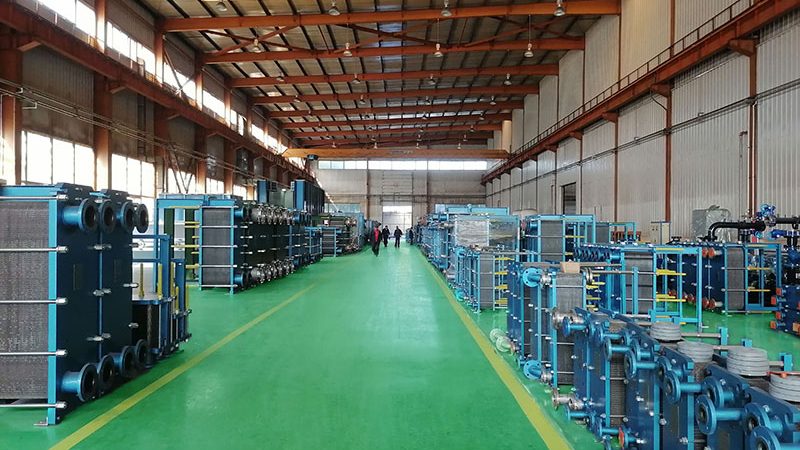
"When will it arrive?" is one of the first questions a buyer asks, and the answer in a quote is often a single figure such as "8 weeks". That figure rarely covers the whole journey. A heat exchanger from China goes through several stages before it reaches your site: technical clarification, drawing approval, materials, manufacturing and testing, inspection, packing and export, sea freight, and import clearance. Each stage has its own owner and its own ways of losing time.
This guide goes through the stages in order, shows where time is usually lost, and lists what you can do to shorten it. It does not give one lead time for all heat exchangers, because there is none: a standard gasketed plate unit and a code-stamped shell-and-tube exchanger in a special alloy are very different jobs. When you are ready to ask for prices, see what data to send before a heat exchanger quote, or send your project through the RFQ form.
1. Read What the Quoted Lead Time Covers
Before comparing lead times, check when each one starts and where it ends. Typical wording, and what it means:
| Wording in the quote | What it means |
|---|---|
| "X weeks after order" | The clock starts when the order is placed. Uncommon for engineered units. |
| "X weeks after drawing approval and advance payment" | The usual wording for engineered units. Any delay in approving drawings or paying the deposit is added to the delivery date. |
| "Ex works" | The unit is ready for collection at the factory. Export, freight and import are still ahead. |
| "FOB Shanghai" | The unit is loaded on board a vessel in Shanghai. Sea freight and import are still ahead. |
Two quotes of "8 weeks" can therefore be several weeks apart in practice. Ask every supplier to state the lead time from the same starting point to the same delivery point, so the quotes can be compared.
2. Before Manufacturing: Clarification and Drawing Approval
Most industrial heat exchangers are built to order. Before the factory starts, the supplier and the buyer settle the technical details and the buyer approves a datasheet and general arrangement drawing. Every round of questions between time zones costs days. The most common causes of delay at this stage are:
- missing data, such as the design pressure, the allowable pressure drop or a fouling factor;
- the design code or the required certificates being decided only after the order;
- late changes to nozzle positions, connection standards or the frame size;
- drawings waiting for comments from several departments on the buyer's side.
The cure is simple but needs discipline: send complete data with the RFQ, name one person who collects all comments on the drawings, and agree how many working days each side has to respond.
3. Materials: Standard or Special
Material availability often decides the lead time more than the factory's workload.
- Plate heat exchangers. Plates are pressed in the manufacturer's own press tools, so the plate must be a model the manufacturer already makes. Stainless steels such as 316L are widely available. Titanium, high-alloy stainless steels such as 254 SMO and nickel alloys may have to be ordered. Gaskets in standard NBR or EPDM grades are easier to source than special compounds such as FKM or food-grade grades.
- Shell-and-tube heat exchangers. Tubes, forgings for flanges and tubesheets, and plate for the shell all have to arrive before welding can start. Special alloys and large forgings usually take the longest. Pressure parts also need material certificates, for example to EN 10204 3.1, which the supplier has to obtain with the material.
- Welded and plate-and-shell units. Pressed plates, welding and testing of the pack add steps that a gasketed unit does not have.
Ask each supplier which materials are in stock, which have to be ordered, and when they are expected to arrive.
4. Manufacturing, Testing and Inspection
Manufacturing includes cutting and pressing, welding, non-destructive testing where required, assembly, the hydrostatic test, drying, painting and the nameplate. Two things outside the workshop often decide the end date:
- Code inspection. Units built to the ASME code need an Authorized Inspector. Units for Europe under the Pressure Equipment Directive need a notified body for every category above the lowest. Their visits have to be booked.
- Third-party and customer inspection. If you or your inspector want to witness the hydrostatic test or the final inspection, the dates must be planned. A unit that has passed its test can wait days for an inspector who was not booked in time.
Agree an inspection and test plan with the order, with the witness points and the notice period for each, as described in the petrochemical supplier checklist.
5. Check Early Whether an Export Licence Is Needed
Most heat exchangers leave China without an export licence. One group is an exception: small heat exchangers and condensers in which all surfaces in contact with the process chemicals are made of certain corrosion-resistant materials. These are on the international chemical weapons control lists, and the EU dual-use list has them as item 2B350.d: heat exchangers or condensers with a heat transfer surface area greater than 0.15 m² and less than 20 m², and the tubes, plates, coils or blocks designed for them, where all wetted surfaces are made of materials such as:
- titanium or titanium alloys;
- nickel or alloys with more than 40% nickel by weight, or alloys with more than 25% nickel and 20% chromium;
- tantalum, zirconium or niobium and their alloys;
- graphite, glass or glass lining, fluoropolymers, silicon carbide or titanium carbide.
China has controlled the same group of equipment since its 2002 measures on the export of chemicals and related equipment. Since 1 December 2024, these measures have been replaced by China's Regulation on Export Control of Dual-Use Items. To apply for a licence, the exporter submits, among other documents, proof of the end user and the end use. The Ministry of Commerce then has 45 working days from accepting the application to decide.
Whether a particular unit is covered depends on its design, its materials and how it is classified, so this is a question for the supplier, not a rule of thumb. If your unit is small and uses titanium, a nickel alloy or another of these materials, ask the supplier at the quotation stage whether it needs a licence, and allow for the review time and for the end-user documents you will be asked to provide.
6. Packing, Export Clearance and Booking
Between "ready at the factory" and "on board" there are still several steps: packing in export crates, the export customs declaration, booking space on a vessel and moving the cargo to the port. Units that fit in a standard container are the easiest. Oversized units travel on flat racks or as breakbulk cargo, which have fewer sailings and need more planning. Ask the supplier which type of shipment it expects, and confirm early who books the freight, which depends on the Incoterm you agree.
7. Sea Freight Times
Port-to-port transit times from Shanghai, from published sources:
| Route | Typical transit | Source |
|---|---|---|
| Shanghai to Los Angeles / Long Beach | About 14 days | Port Economics, Management and Policy |
| Shanghai to New York via the Panama Canal | About 28 days | Port Economics, Management and Policy |
| Shanghai to Rotterdam via the Suez Canal | 32 to 35 days | SEKO Logistics |
| Shanghai to Rotterdam via the Cape of Good Hope | 45 to 60 days | SEKO Logistics |
Since late 2023, security concerns in the Red Sea have led major carriers to send Asia–Europe services around the Cape of Good Hope instead of through the Suez Canal, which adds about two weeks per voyage. Transpacific routes are not affected. These are port-to-port times: add the time for loading, transhipment, port congestion, import clearance and delivery to site. Routes and schedules change, so ask your freight forwarder for the current figure for your ports.
8. Holidays in China
Two national holidays affect factories and logistics every year:
- National Day "Golden Week", which starts on 1 October and usually lasts about a week.
- Chinese New Year, which falls on 6 February in 2027. Factories slow down in the weeks before it, many stop completely for about two weeks around it, and it takes several more weeks after the holiday to get back to full capacity.
If a unit has to be shipped in the first quarter, place the order early enough to finish manufacturing before the Chinese New Year slowdown, or plan for delivery after it.
9. A Worked Example
The numbers below are assumptions to show how the stages add up, not typical values. Suppose a supplier quotes 8 weeks ex works after drawing approval for a gasketed plate heat exchanger going to Rotterdam:
| Stage | Assumed time |
|---|---|
| Drawing approval after the order | 2 weeks |
| Manufacturing and factory testing (the quoted lead time) | 8 weeks |
| Witnessed inspection and packing | 1 week |
| Export clearance and loading | 1 week |
| Sea freight via the Cape of Good Hope | 7 to 9 weeks (45 to 60 days) |
| Import clearance and delivery to site | 1 week |
| Total from order to site | 20 to 22 weeks |
In this example the quoted "8 weeks" is less than half of the time from order to site. To Los Angeles, with about 2 weeks at sea, the same unit would take about 15 weeks.
10. How to Shorten the Lead Time
- Send complete thermal and mechanical data with the RFQ, so the quote is right the first time.
- Decide the design code and the documents you need before ordering.
- Return drawing comments within an agreed number of days, through one person.
- Where the duty allows, choose plate models, materials and gasket grades the supplier has in stock.
- Agree the inspection and test plan at order and book inspectors early.
- Check whether an export licence is needed at the quotation stage.
- If a spare part is urgent, ship it separately by air.
- Plan orders around Golden Week and Chinese New Year.
What This Means for Buyers
A lead time is only useful if you know what it includes. Ask each supplier for a milestone schedule with the quote: drawing submission, material arrival, hydrostatic test, inspection, ready ex works, and the expected departure and arrival of the vessel. Compare suppliers on the same basis, and add your own approval time and the freight time to your port. For more on preparing a complete enquiry, see the heat exchanger RFQ checklist and how to verify a Chinese heat exchanger manufacturer.
Sources and Related Pages
- Regulation (EC) No 428/2009, Annex I, item 2B350.d, as published on legislation.gov.uk: https://www.legislation.gov.uk/eur/2009/428/annex/I
- Measures for Export Control of Relevant Chemicals and Related Equipment and Technologies (China, 2002), WTO import licensing notification: https://importlicensing.wto.org/sites/default/files/members/31/Measures%20-%20Control%20of%20Exports%20of%20Relevant%20Chemicals%20and%20Related%20Equipment%20and%20Technologies_19.10.2002.pdf
- Orrick, China issues Regulation on Export Control of Dual-Use Items (November 2024): https://www.orrick.com/en/Insights/2024/11/China-Issues-Regulation-on-Export-Control-of-Dual-Use-Items
- Port Economics, Management and Policy, routing options between Shanghai, Rotterdam and New York: https://porteconomicsmanagement.org/routing-options-shanghai-rotterdam/
- SEKO Logistics, Asia–Europe trade lane guide: https://www.sekologistics.com/en/resource-hub/knowledge-hub/asia-europe-trade-lane-guide-mastering-the-worlds-largest-shipping-corridor-in-2026/
- SEKO Logistics, Lunar New Year supply chain planning guide: https://www.sekologistics.com/en/resource-hub/knowledge-hub/lunar-new-year-complete-supply-chain-planning-guide-for-asia-sourcing/
- HeatEx Direct, what data to send before a heat exchanger quote: https://heatexdirect.com/industry-news/posts/what-data-to-send-before-heat-exchanger-quote
- HeatEx Direct, petrochemical heat exchanger supplier checklist: https://heatexdirect.com/industry-news/posts/petrochemical-heat-exchanger-supplier-checklist