
Brazed Plate Heat Exchangers: Copper, Nickel or Stainless Brazing?
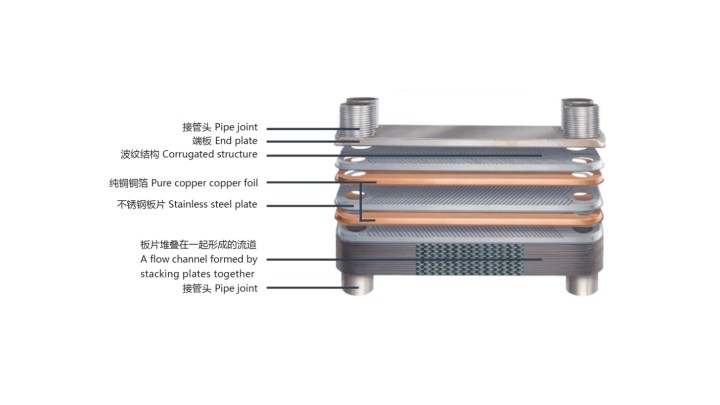
A brazed plate heat exchanger (BPHE) is a stack of stainless steel plates joined by a brazing material in a vacuum furnace. There are no gaskets and no frame, so the unit is small, light and cheap for its duty. That is why brazed units are everywhere in heat pumps, chillers, district heating substations, oil coolers and domestic hot water systems.
The plates are usually AISI 316L. What varies is the brazing material, and buyers often overlook it. THT Juyuan, for example, offers brazed plate heat exchangers with copper-based foil, nickel-based paste or iron-based paste. This guide explains when each one fits and what to tell suppliers.
1. Why the Brazing Material Matters
During brazing, the filler metal melts, wets the plates and is drawn by capillary action into the gaps at every contact point between the plates. When it cools, it forms the joints that hold the stack together and seal the edges. Both fluids therefore touch the brazing material as well as the stainless steel plates.
This means the corrosion resistance of a brazed unit is set by two materials. Alfa Laval's guideline on water quality for brazed units sums it up: copper limits the overall water composition, while stainless steel is limited by the chloride content. If the brazing material corrodes, the unit can leak between the two circuits, and a brazed unit cannot be opened and repaired. It has to be replaced.
2. Copper Brazing: The Default for Clean Water and Most Refrigerants
Most brazed plate heat exchangers are copper-brazed. Copper brazing is well proven, gives strong joints and is the cheapest option. It suits closed heating and cooling circuits, district heating water of good quality, most refrigerants other than ammonia, and oil coolers.
Copper is sensitive to water chemistry, however. Alfa Laval gives these limits to avoid copper corrosion in its brazed units:
| Parameter | Limit for copper-brazed units |
|---|---|
| pH | 7.5–9.0 |
| Total hardness | 4.5–8.5 °dH |
| Free chlorine | < 1.0 ppm |
| Conductivity | < 500 µS/cm |
| Ammonia (NH₃) | < 0.5 ppm |
| Sulphate (SO₄²⁻) | < 100 ppm |
| Hydrogen carbonate (HCO₃⁻) | 60–200 ppm |
| Ratio HCO₃⁻ / SO₄²⁻ | > 1.5 |
| Ratio (Ca + Mg) / HCO₃⁻ | > 0.5 |
Other manufacturers publish similar tables with slightly different numbers, and all of them say the values reduce the risk of corrosion but do not guarantee against it. If your water is outside these limits, copper brazing is the wrong choice, or the water needs treatment first.
The most important exclusion is ammonia. Ammonia attacks copper, so a copper-brazed unit must never be used with ammonia as a refrigerant. SWEP's refrigerant handbook states that brazed plate heat exchangers for ammonia must use a nickel-based brazing material.
3. Nickel Brazing: For Ammonia and Water That Copper Cannot Handle
Nickel-based brazing materials resist ammonia and a wider range of water chemistry. They are the usual choice for:
- ammonia refrigeration and heat pumps;
- water with ammonia, high sulphate, low pH or high conductivity, where copper would corrode;
- processes where copper ions in the fluid are a problem, for example some high-purity water circuits.
Danfoss's water quality guideline for its brazed units shows how much the brazing material changes the picture. It rates copper (Cu), copper-nickel (CuNi) and stainless steel (StS) brazing separately:
| Water condition | Cu brazing | CuNi brazing | StS brazing |
|---|---|---|---|
| pH 6.0–7.5 | Risk of corrosion | Possible corrosion | Good |
| Conductivity above 1,000 µS/cm | Not recommended | Possible corrosion | Good |
| Ammonia 2–20 mg/l | Possible corrosion | Possible corrosion | Good |
| Ammonia above 20 mg/l | Not recommended | Not recommended | Good |
| Sulphate above 300 mg/l | Not recommended | Not recommended | Good |
| Free chlorine above 5 mg/l | Not recommended | Not recommended | Not recommended |
Danfoss does not rate a pure nickel brazing material in this table. What it shows is that adding nickel to a copper braze helps only in some conditions, while a stainless braze removes most of the water limits. When a supplier offers a "nickel-brazed" unit, ask whether the filler is nickel-based or a copper-nickel alloy.
Nickel is not a cure for everything. Free chlorine is a problem for every version, and nickel can itself be a contaminant: Alfa Laval markets its copper- and nickel-free units precisely to prevent nickel or copper contamination of drinking water and other hygienic fluids. Pressure and temperature ratings can also differ between the copper and nickel versions of the same model, so compare the datasheet values for the exact version offered.
4. Copper-Free Units: Iron-Based Brazing and Fusion Bonding
Where neither copper nor nickel is acceptable, there are two copper-free options:
- Iron-based (stainless) brazing materials. Höganäs, a maker of brazing alloys, describes its iron-chromium-based filler as a cost-effective alternative to nickel-based fillers with similar corrosion resistance and joint strength, and as a first choice where copper-free brazing is required, such as drinking water applications and oil coolers. THT Juyuan's iron-based paste option belongs to this group.
- Fusion-bonded all-stainless units. Alfa Laval's AlfaNova units are made of stainless steel plates bonded without any copper or nickel. Alfa Laval positions them for duties with high cleanliness demands, aggressive media such as ammonia, or where copper or nickel pose contamination risks.
Copper-free units usually cost more than copper-brazed ones and come in fewer sizes, so they are worth specifying only where the duty needs them.
5. What the Brazing Material Does Not Change
Whatever the brazing material, the plates are still stainless steel, and stainless steel is limited by chlorides. Alfa Laval's limits for its SS316 brazed units to avoid crevice corrosion are:
| Temperature | Max. chloride at pH 7 | Max. chloride at pH 9 |
|---|---|---|
| 25 °C | 1,000 ppm | 6,000 ppm |
| 50 °C | 300 ppm | 1,500 ppm |
| 80 °C | 100 ppm | 600 ppm |
Danfoss gives its own limits for its 316L brazed units, set to avoid stress corrosion cracking: 1,000 mg/l up to 20 °C, 400 mg/l up to 50 °C, 200 mg/l up to 80 °C and 100 mg/l at 100 °C and above. The two makers set their limits differently, so use the values of the manufacturer you actually buy from.
So a brazed unit of any kind is not a seawater heat exchanger. For seawater and brackish water, look at titanium plates in gasketed or welded designs; see the marine and seawater checklist.
Two other limits apply to every brazed unit:
- It cannot be opened. Cleaning is by circulating a cleaning solution only, so heavily fouling fluids need a gasketed or wide-gap design instead.
- Thermal and pressure cycling fatigue the joints. Frequent starts, steam heating and fast temperature changes shorten the life of brazed units. See the steam service guide and the heat pump and district heating guide.
6. Quick Selection Guide
| Duty | Usual brazing choice |
|---|---|
| Closed heating and cooling circuits, district heating water within the copper limits | Copper |
| HFC, HFO and hydrocarbon refrigerants | Copper (check the pressure rating, especially for CO₂) |
| Ammonia refrigerant | Nickel-based, or a copper-free unit; never copper |
| Water outside the copper limits (low pH, high sulphate, ammonia, high conductivity) | Nickel or stainless brazing, or water treatment |
| Drinking water and hygienic fluids | Check local rules for materials in contact with drinking water; copper-free where copper or nickel release must be avoided |
| High-purity water where metal ions matter | Nickel or copper-free, after checking with the process owner |
| Seawater, brackish water, high chlorides | Not brazed; titanium gasketed or welded |
| Heavily fouling or dirty fluids | Not brazed; gasketed or wide-gap |
7. What to Put in Your RFQ
| Item | What to give |
|---|---|
| Both fluids | Names, concentrations, temperatures and flows |
| Water analysis | pH, conductivity, chloride, sulphate, hydrogen carbonate, ammonia, free chlorine, hardness |
| Brazing material | Required, acceptable or excluded (for example "no copper") |
| Design conditions | Design pressure and temperature of each side |
| Operation | Starts and stops per day, steam or not, rate of temperature change |
| Approvals | Pressure equipment code, refrigerant approvals, drinking water approvals where needed |
| Cleaning | Planned cleaning method and access for cleaning connections |
The RFQ checklist covers the general data every heat exchanger quote needs. When you send an RFQ through HeatEx Direct, include the water analysis and the brazing requirement, and we will ask the manufacturers to confirm the brazing material in writing in their offer.
What This Means for Buyers
The brazing material is part of the material specification, not a detail for the factory to decide. Copper is right for most clean water and refrigerant duties. Ammonia, aggressive water and some high-purity duties need nickel or a copper-free unit, and drinking water may need a copper-free design depending on local rules. Seawater and dirty fluids need a different type of heat exchanger altogether. A water analysis and one line in the RFQ, "brazing material: copper / nickel / copper-free", prevent most of the problems.
Sources and Related Pages
- Alfa Laval, Guideline on water characteristics to avoid corrosion, brazed plate heat exchangers: https://assets.alfalaval.com/documents/pa7bdc97d/alfa-laval-guideline-on-water-characteristics-to-avoid-corrosion-bhe-product-leaflets-en-gb.pdf
- Danfoss, Guidelines for water quality in Danfoss brazed heat exchangers with plates of EN 1.4404 ~ AISI 316L: https://assets.danfoss.com/documents/192076/BC396577843421en-000101.pdf
- SWEP refrigerant handbook, practical advice: https://swep.net/refrigerant-handbook/8.-practical-advice/qw7
- Alfa Laval, fusion-bonded plate heat exchangers: https://www.alfalaval.com/products/heat-transfer/plate-heat-exchangers/fusion-bonded-plate-heat-exchangers/
- Höganäs, BrazeLet F300 iron-based brazing filler metal: https://www.hoganas.com/en/powder-technologies/products/brazelet/brazelet-f300/
- THT Juyuan brazed plate heat exchanger on HeatEx Direct: https://heatexdirect.com/products/siping-juyuan-hanyang-plate-heat-exchanger-co-ltd/brazed-plate-heat-exchanger