
Hilton Tianjin Eco-City: Accessen Heat Exchange Units for Heat Recovery, Free Cooling and Steam Heating

A hotel needs hot water and air conditioning every day of the year, so its energy system has a large effect on running costs. The Hilton Tianjin Eco-City shows how heat exchange units can make that system more efficient by reusing heat that would otherwise be thrown away.
The Hotel
According to Accessen, the Hilton Tianjin Eco-City was the first Hilton-brand hotel in Tianjin and the first international-brand hotel in the Sino-Singapore Tianjin Eco-City. It stands at 82 Dongman Middle Road in the southern part of the Eco-City, on a site of 80,000 m². Its design is modelled on a Qing-dynasty prince's mansion, with five guest-room buildings around five courtyards and 301 rooms and suites.
The project holds China's three-star green building label, the highest level of the national green building rating, and was the first hotel in the district to receive a national green building label. Its measures include a high-performance building envelope with double-glazed windows, renewable energy, a fresh-air system with heat recovery from exhaust air, and rainwater reuse.
Heat Pumps Supply Most of the Hot Water
For hot water, ground-source heat pumps are the main heat source and account for 60.78% of the energy used by the hot water system. In summer, waste heat from the heat pumps preheats the domestic hot water through a plate heat exchanger, and solar collectors then heat it further.
The reasoning is simple. When a heat pump cools a building in summer, it must reject the heat it removes. Without heat recovery, that heat goes into the ground loop or the atmosphere. A heat exchanger can pass part of it to the cold water that feeds the hot water system, so the hotel needs less gas or electricity to heat that water.
Three Accessen Heat Exchange Units
The hotel's air conditioning combines ground-source heat pumps, electric chillers and plate heat exchange units. Guest rooms use fan coil units with fresh air, and air handling units with heat recovery treat the fresh air for rooms, the ballroom, the lobby and restaurants. Accessen supplied three units for the system:
| Unit | Capacity | Function |
|---|---|---|
| ABJ-SA steam-water heat exchange unit | 5,200 kW | Turns steam from the boilers into hot water for heating |
| ABJ-WG water-water heat recovery unit | 583 kW | Recovers waste heat for reuse |
| ABJ-WG water-water free cooling unit | 600 kW | Provides chilled water from a natural cold source without running chillers |
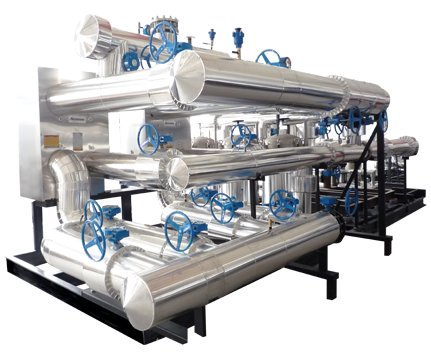
Free cooling means using a cold source such as cooling tower water in cold weather to cool the chilled water through a plate heat exchanger, so the chillers can stay off. Together with heat recovery, it is one of the main ways the hotel reduces the energy used by its heating and cooling plant.
Each ABJ unit is built around plate heat exchangers, which transfer heat efficiently in a compact space and are easy to maintain. According to Accessen, the units have control systems that monitor operating data and adjust operation automatically, and the heat recovery system has run stably since it was put into operation.
What Hotel Owners Can Take From This
A hotel runs around the clock, so equipment failures directly affect guests. The Tianjin Eco-City project shows that heat recovery and free cooling do not need complicated equipment: packaged units built around plate heat exchangers can be added to a heat pump system to reuse waste heat and cut the energy needed for hot water and air conditioning. For a similar project, the key data are the heat pump's operating modes, the daily hot water demand and the temperatures available on each side of the heat exchanger. These decide how much waste heat can actually be recovered.