
Dusty Dryer Exhaust: How an Accessen All-Welded Air Preheater Saves 2,000 Tonnes of Steam a Year at Solbar Ningbo Protein
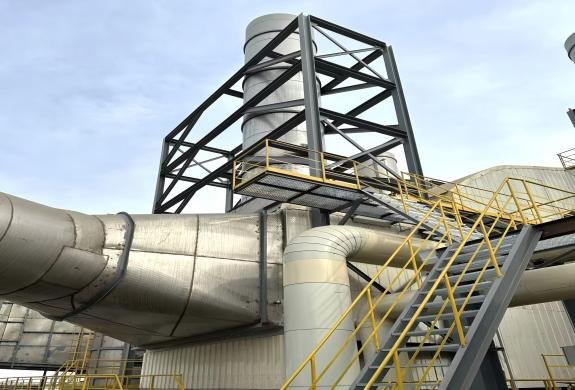
Food and plant protein plants release large volumes of warm process exhaust, and that exhaust often carries fine dust. Many plants that install heat recovery find that within a few months the plates are clogged with dust, heat transfer drops sharply and the unit has to be stopped again and again for cleaning. The lost production can outweigh the energy saved.
Can heat recovery run reliably on dusty exhaust? Which materials and designs resist dust buildup, and what must not be overlooked during selection? A heat recovery retrofit at Solbar Ningbo Protein Technology shows what worked.
The Customer
Solbar Ningbo Protein Technology Co., Ltd. is a specialist plant protein producer focused on soy protein. It combines more than 30 years of production technology and R&D from Solbar of Israel with over 20 years of experience behind its Chinese brand Wonderful. The company runs three fully automatic production lines imported from Europe, the United States and Israel, has a production line for 30,000 tonnes of textured soy protein, and was listed on the main board of the Shanghai Stock Exchange in December 2023 (stock code 603231).
Why Dust Defeats Ordinary Heat Recovery
The drying process in soy protein production releases exhaust at about 68 °C, carrying fine protein dust that is light and sticky. In an ordinary heat exchanger with narrow channels and rough plate surfaces, this dust easily sticks to the heat transfer surface. Once the plates are coated, the dust layer acts as insulation, heat transfer falls steadily, and the unit must be stopped, opened and washed by hand. Most food lines run all year, so every stop delays orders and costs money.
There are also hygiene and sealing issues. Carbon steel rusts in humid exhaust, and rust flakes in the air stream are a food safety risk. Older heat exchangers sealed with rubber gaskets suffer too: warm exhaust containing traces of organic matter ages the gaskets quickly, they crack, exhaust leaks out, heat is lost and the workshop environment suffers.
The Solution: Smooth, All-Welded and Wider Channels
At Solbar Ningbo, Accessen supplied an AWK series all-welded gas-to-gas heat exchanger, used as an air preheater, for the heat recovery retrofit of a soy protein project with a capacity of 10,000 tonnes a year. The unit uses the heat of the 68 °C exhaust to preheat the air that enters the drying system, which reduces the steam needed for drying.
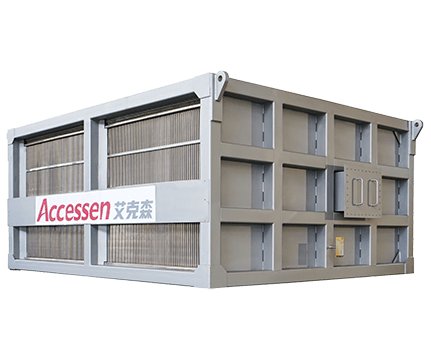
The design answers each of the problems above:
- Mirror-polished food-grade plates. After technical discussions with the customer, Accessen chose food-grade plates with a mirror finish (the so-called 8K finish). The smooth surface reduces friction between the dust and the wall, so the fast-moving air carries most of the dust out of the unit. This gives a self-cleaning effect in operation, extends cleaning intervals and reduces stops.
- All-welded, no gaskets. The plates are welded together, so there are no rubber gaskets to age, crack and leak in the warm exhaust.
- Wider channels. The channels were widened to give the dust room to pass, so they do not clog easily.
- Modular construction. If operating conditions change later, heat transfer modules can be added or removed, which makes it easier to follow future capacity increases.
Results
Since the retrofit went into operation, the plant has saved about 2,000 tonnes of steam and more than RMB 600,000 in production costs a year, and its carbon emissions have fallen. According to Accessen, the unit keeps running reliably even though the exhaust always carries dust, and the project has become a reference for heat recovery retrofits in the soy protein industry.
Selection Points for Dusty Exhaust
Many buyers compare only heat transfer coefficients and overlook whether the unit suits the actual conditions. For dusty exhaust, Accessen recommends checking four things:
- Material. In food processing, use food-grade stainless steel with a mirror finish, which resists sticking and meets hygiene requirements.
- Sealing. For warm, dusty exhaust, avoid gasketed designs where possible and choose all-welded construction.
- Channel design. Do not choose a unit with narrow, tightly spaced channels, where particles can settle and build up.
- Custom design. Exhaust temperature, dust content and air flow differ from plant to plant, so a standard unit may not fit. At Solbar Ningbo, Accessen's engineers studied the exhaust before choosing the plate finish.
Operation and Maintenance
Good operation extends the life of even a well-designed unit. Record the inlet and outlet temperatures and the pressure drop. A clear rise in pressure drop means dust is starting to build up on the plates, and a simple blow-down during a production break is then usually enough, without taking the unit apart. Avoid running above the design air flow, since higher velocities increase wear, while velocities that are too low let dust settle.
Dusty exhaust is a demanding duty. The more carefully the conditions are studied before the project, the less maintenance is needed afterwards. For food plants, the best value is not the cheapest unit but one that suits the exhaust, stops rarely and delivers energy savings year after year.