
Qatar Desalination Case: Accessen Heat Exchangers at the Ras Girtas Power and Water Plant
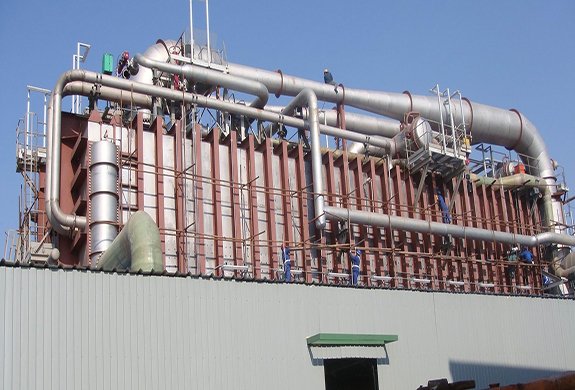
The Trouble With Old Equipment: High Energy Use and Hard Maintenance
In desalination, chemicals and HVAC, many plant managers and engineers face the same problem: old heat exchangers are inefficient and expensive to maintain.
Conventional shell-and-tube heat exchangers and poorly designed plate units often have badly chosen flow velocities, which lets fouling build up. Once scale forms, heat transfer drops sharply, and more heat has to be supplied to hold the process temperature, so energy use rises. Old units are also hard to clean, and replacing seals takes a lot of time and labor. This raises maintenance costs and causes unplanned shutdowns that hold up production.
The Project: Ras Girtas Power Company, Qatar
Ras Girtas Power Company operates a power and water plant at Ras Laffan on the coast of Qatar and is one of the country's key providers of electricity and water. The plant has a generating capacity of 2,730 MW, which Accessen puts at about 30% of Qatar's power capacity, and a desalination capacity of 63 million imperial gallons a day, about 286,000 m³ of drinking water per day.
For a project of this size, the key questions were clear: how to recover as much energy as possible in a large combined power and water plant, and how to keep the equipment running reliably for many years.
The plant uses multiple-effect distillation (MED) technology from the French company Sidem. MED is easier to operate than membrane desalination, but it places high demands on its heat exchange equipment. In each effect, heat is transferred and converted again and again, and only efficient heat exchangers that recover this heat can bring down the energy use and the cost of each cubic meter of water.
What Accessen Supplied, and Why
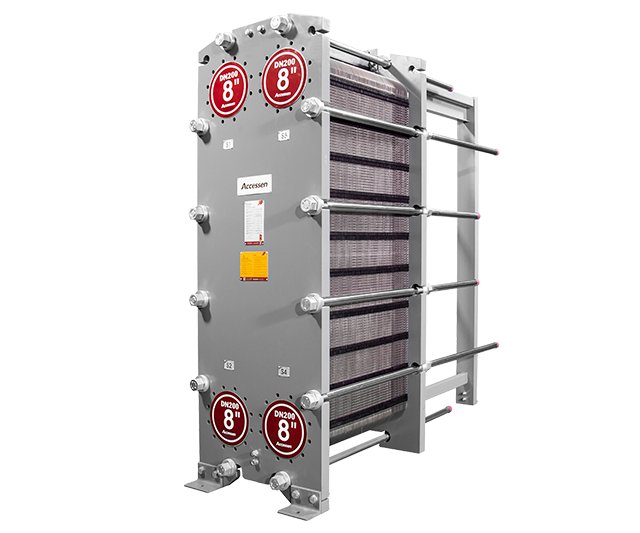
In 2009 the project chose Accessen's AN15 series gasketed plate heat exchangers, and in 2016 its AWD80 series all-welded heat exchangers. Three features explain why Accessen was chosen for the project among many international brands:
- Clip-on gaskets for easy maintenance. Replacing gaskets is one of the most tedious jobs for maintenance staff. Accessen uses clip-on gaskets that need no glue, which makes dismantling and reassembly much simpler. Together with a leak-prevention design, this extends gasket life and makes routine cleaning far easier, reducing labor costs and downtime.
- Plate designs that turn pressure drop into performance. Many heat exchangers give up heat transfer to reduce resistance. Within the same port size, Accessen offers plates with different corrugation angles, groove depths and length-to-width ratios, so the available pressure drop can be used to the full. An improved distribution area spreads the flow evenly across the plate and removes the dead zones where fouling builds up. The corrugations create strong turbulence and allow a temperature approach as close as 0.5–1 °C, recovering nearly every degree of usable heat.
- Safety and reliability in harsh service. For corrosive, high-pressure desalination duties, the plates are available in AISI 304, 316 and 316L, titanium and 254 SMO. Self-locking features at the four corners of each plate keep the pack aligned through repeated heating and cooling. The units are rated up to 200 °C and 25 bar, and individual units at Ras Girtas handle duties of up to 7,341 kW.
Selection Range
For engineering and procurement teams, the main limits of Accessen's industrial gasketed plate heat exchangers are:
- Flow rate up to 5,000 m³/h
- Design pressure up to 25 bar
- Heat duty up to 80 MW
- Operating temperature up to 200 °C, with a temperature approach as close as 0.5–1 °C
- Plate materials including AISI 304, 316 and 316L, titanium and 254 SMO
- Typical series: AU, AN, AS, AP and AC
How Heat Is Recovered in an MED Plant
In an MED plant, heating steam condenses in each effect and gives up its latent heat, which evaporates part of the seawater on the other side of the heat transfer surface. The vapor produced becomes the heating steam for the next effect, and the condensed vapor becomes the distilled product water. The vapor from the last effect is condensed in a final condenser.
Because the plates create strong turbulence, a plate heat exchanger keeps a high heat transfer coefficient even at low velocity. Combined with a power plant, the MED process uses steam from the turbines. Accessen regards this cogeneration of power and water as one of the most energy-efficient routes to desalination, with relatively low capital intensity.
Old Versus New
- Before: with conventional equipment, the channels clogged easily and cleaning required chemicals or long sessions with high-pressure water jets. Gaskets aged and leaked, with the risk of the two fluids mixing.
- After: with Accessen gasketed plate heat exchangers, the dead zones where fouling builds up are gone, flow velocities are well chosen and maintenance downtime is shorter. Glue-free gaskets seal more reliably, and the improved distribution area spreads the flow evenly.
From Ras Girtas in Qatar to Shougang's Caofeidian phase II and Baosteel's Zhanjiang plant, Accessen heat exchangers have proven themselves in desalination and heavy industry. They are used in marine freshwater generation, power plants including nuclear power, petrochemicals and HVAC. For the full product range, see the Accessen AU, AN, AS, AP and AC series gasketed plate heat exchangers.