
Technical Analysis: Industrial Applications of HT-Bloc All-Welded Plate Heat Exchangers
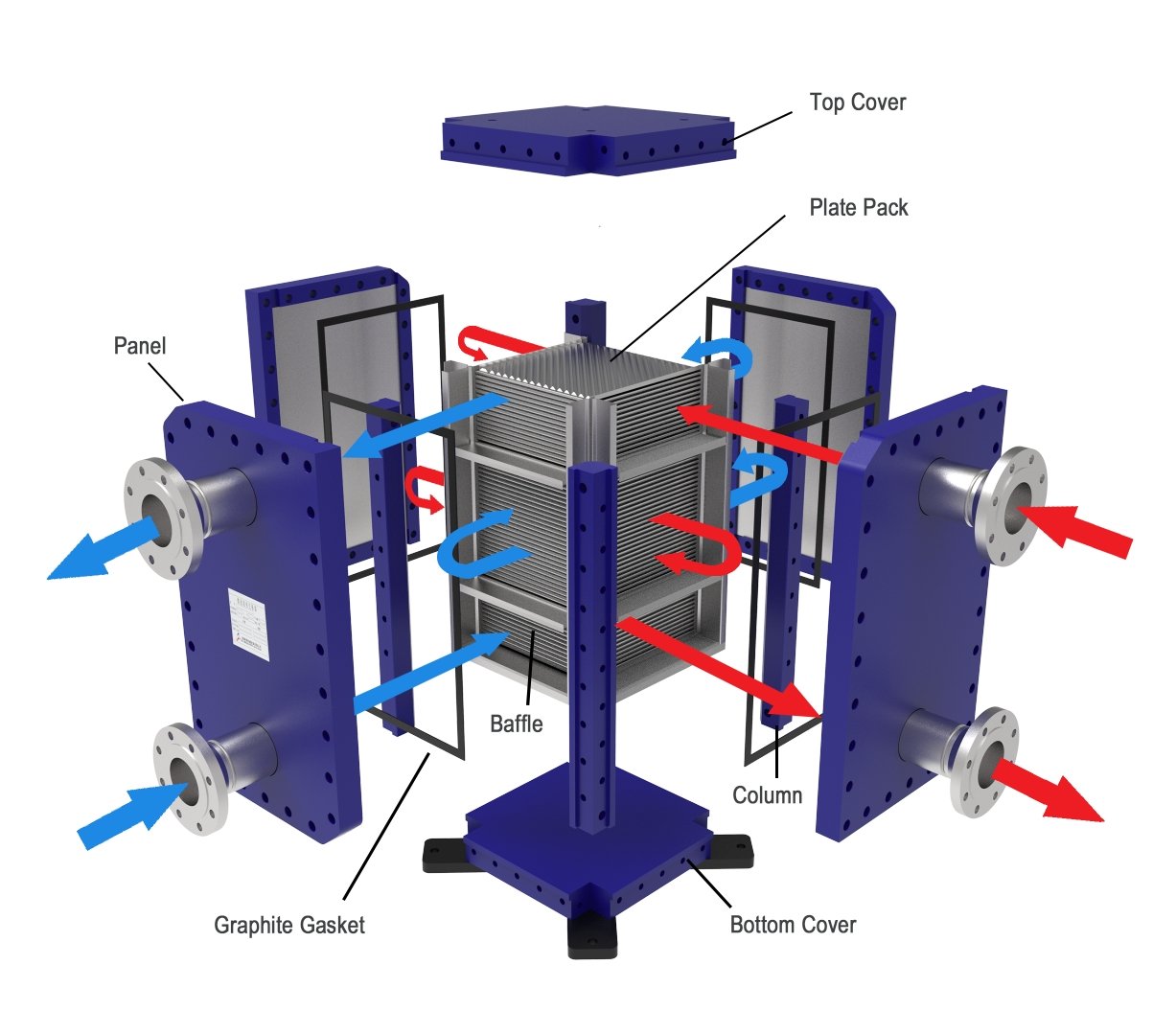
1. Energy Efficiency and Safety Transformation in the Petrochemical Industry
The petrochemical industry is a typical high-risk, high-complexity industrial sector with stringent requirements for equipment safety and reliability. From crude oil entering a refinery to being converted into plastics, fuels, or chemicals, heat transfer is critical. In this field, HT-Bloc represents not only a replacement for legacy equipment but also a fundamental process optimization solution.
1.1 Refinery Units: Breakthroughs in Crude Preheat Trains and Distillation (CDU/VDU)
The Crude Distillation Unit (CDU) is the primary processing stage and the facility's largest energy consumer. Before entering the atmospheric distillation tower, crude oil passes through a complex preheat train, where its temperature is raised to 280°C-300°C by recovering heat from side draws and bottom residues. It is then further heated to about 360°C in the furnace before entering the tower. Furnace fuel consumption directly determines refinery processing costs and carbon emissions.
Critical Challenges: Fouling and Thermal Efficiency Bottlenecks
- Asphaltene fouling: Crude oil is a complex mixture containing asphaltenes, inorganic salts, wax, and suspended solids. In traditional shell-and-tube heat exchangers, low flow velocity and baffle dead zones cause asphaltenes to precipitate and polymerize because of temperature gradients, forming hard coke layers.
- Thermal resistance surge: The fouling layer has low thermal conductivity, causing performance to degrade exponentially. Operators must increase furnace load to maintain tower-bottom temperature, causing fuel consumption to rise sharply.
- Increased maintenance cost: Refineries typically require cleaning cycles every few months, often requiring shutdown for tube bundle extraction.
HT-Bloc Solutions
HT-Bloc demonstrates strong adaptability in crude oil cooling and crude/residue heat exchange applications.
- High shear force inhibits fouling: The corrugated plates of HT-Bloc produced by Shanghai Heat Transfer Equipment Co., Ltd. generate high-intensity turbulence and extremely high wall shear stress, effectively stripping initially deposited asphaltene precursors and making fouling difficult to adhere. Field data shows that under the same operating conditions, HT-Bloc's fouling rate is only 10%-20% of that of shell-and-tube heat exchangers, significantly extending cleaning intervals.
- Ultimate heat recovery: With a fully counter-current design, HT-Bloc achieves a terminal temperature difference (approach temperature) as low as 3°C-5°C.
- Space and layout optimization: A single HT-Bloc unit can replace 4-8 shell-and-tube heat exchangers in series, occupying only 10%-20% of the footprint and reducing weight by more than 80%. This frees valuable space for revamp projects and capacity upgrades.
- Economic impact: For a 10-million-ton refinery, every 1°C increase in crude furnace inlet temperature can save millions in fuel cost annually and reduce thousands of tons of CO2 emissions.
1.2 Gas Treatment: Corrosion Control in Amine Sweetening Systems
In gas plants and refineries, amine solutions such as MDEA are used to absorb hydrogen sulfide (H2S) and carbon dioxide (CO2) as a standard desulfurization and decarbonization process. The lean/rich amine exchanger is the core energy-saving unit.
Critical Challenges: Stress Corrosion and Zero Tolerance for Leakage
- HISC and stress corrosion cracking (SCC): H2S is reduced to atomic hydrogen on metal surfaces, causing hydrogen-induced stress cracking (HISC). Rich amine with high acid gas loading (>90°C) is highly corrosive to carbon steel, especially in the weld heat affected zone (HAZ). Traditional units often require expensive post-weld heat treatment (PWHT) or alloy overlay.
- Lethal service risk: H2S is highly toxic. Rubber gaskets in traditional plate exchangers are prone to aging and swelling in high-temperature amine, creating serious safety hazards.
HT-Bloc Advantage: Balancing Economics and Safety
- All-welded safety barrier: The fully welded plate pack eliminates the risk of toxic media leakage caused by gasket failure.
- Material economics: Because the plates are extremely thin (0.8-1.0 mm), the material cost of manufacturing HT-Bloc with stainless steel (316L) is much lower than that of thick-walled shell-and-tube heat exchangers. This makes it economically feasible to adopt corrosion-resistant alloys throughout the amine system and fundamentally solve ASCC problems.
- Energy efficiency: Amine regeneration energy consumption mainly depends on the temperature of rich amine entering the regenerator. With high efficiency, HT-Bloc achieves heat recovery above 90%, greatly increasing rich amine temperature, significantly reducing steam consumption in the regenerator reboiler, and optimizing the thermal balance of the entire desulfurization unit.
2. Hygiene and Thermal Sensitivity Control in Biodiesel Production
In palm-oil-based biodiesel production, including pre-esterification, transesterification, distillation, and methanol recovery, heat exchanger performance directly affects product purity, safety, and energy consumption.
2.1 Process Pain Points
- Thermal sensitivity (isomerization): Palm oil with high free fatty acid content undergoes pre-esterification (60-80°C), transesterification (60-65°C), and distillation (200-300°C). Excessive residence time at high temperature or uneven heating can cause fatty acid isomerization and ester thermal degradation, producing harmful impurities such as aldehydes and acidic byproducts. This increases acid value and reduces purity. Heating and cooling of palm oil feedstock and reaction products must be rapid and uniform, with strict control of high-temperature residence time to avoid local overheating.
- High energy demand: The core processes of palm-oil biodiesel production require a stable heat source. Recovering waste heat from high-temperature reaction products (60-80°C) and distillation tower overhead vapor (64.7°C and above) to preheat cold feedstock is critical. Waste heat recovery is mainly handled by economizers, and heat recovery efficiency directly determines plant energy cost.
- Difficult cleaning: After long-term operation, gums in palm oil, soaps formed during reaction, residual catalyst particles, and other substances tend to polymerize and deposit on heat exchanger walls, forming fouling. This reduces heat transfer efficiency, increases energy consumption, and shortens equipment life.
2.2 HT-Bloc Hygienic and Energy-Saving Solutions
- Precise temperature control and quality assurance: HT-Bloc has extremely low hold-up volume. The residence time of palm oil feedstock, reaction mixture, and distillation material in the high-temperature zone can be measured in seconds. The corrugated plates are designed by Shanghai Heat Transfer Equipment Co., Ltd.
- High-efficiency heat recovery: As an economizer, HT-Bloc achieves heat recovery efficiency above 80%, significantly reducing steam and cooling water consumption and meeting green, low-carbon production requirements.
- Accessible and hygienic design: The detachable frame of HT-Bloc allows physical cleaning such as high-pressure water jetting on the plate pack, ensuring long-term stable heat transfer performance and extending service life.